Discover the seven traditional signs of an incubus encounter, explore historical paranormal folklore, and understand the connection between supernatural beliefs and sleep paralysis.
By Kevin Mack | Paranormal Investigator, Researcher, Freelance Writer and Founder of Paraghosts.com | November 24, 2026
Disclaimer: This content shares lifestyle strategies and peer experiences for educational purposes and is not a substitute for professional medical advice, diagnosis, or treatment.This article explores paranormal folklore and documented sleep experiences. It does not establish the existence of supernatural entities.
Key Takeaways
- The traditional signs of an incubus include chest pressure, disturbing dreams, perceived physical contact and a mysterious bedroom presence.
- Incubus legends have appeared throughout centuries of supernatural folklore.
- Sleep paralysis can produce experiences remarkably similar to historical incubus accounts.
- Bedroom chills, shadow figures and unexplained sensations are not reliable evidence of supernatural activity.
- Scientific research documents the incubus phenomenon as a sleep related experience.
- Responsible paranormal investigation begins by considering ordinary explanations.
Introduction
Explore the signs of an incubus according to paranormal lore, including chest pressure, vivid dreams, shadow figures and historical sleep paralysis beliefs.
Imagine waking in the middle of the night, feeling pressure against your chest and sensing that someone is standing beside your bed.
For centuries, experiences like these have been described as signs of an incubus encounter.
As someone with more than 15 years of experience investigating and researching paranormal phenomena, I believe that understanding unexplained experiences requires more than collecting frightening stories.
What helps me approach these subjects is separating what someone experiences from what they believe caused it.
An experience deserves consideration without automatically being classified as supernatural.
Understanding the history of the incubus and its relationship with sleep research provides a more balanced perspective.
Direct Answer:
What Are the Common Signs of an Incubus Encounter?
The traditional signs of an incubus include sudden bedroom chills, heavy chest pressure, temporary inability to move, vivid or disturbing dreams, perceived physical contact and the sensation of an unseen presence. Although paranormal folklore attributes these experiences to a supernatural entity, many closely resemble documented experiences associated with sleep paralysis.
What Is an Incubus in Paranormal Folklore?
An incubus is a supernatural male entity described in European folklore and medieval demonology. Traditional accounts describe it as visiting sleeping individuals and engaging in unwanted intimate contact.
“Understanding where a paranormal belief originated is just as important as understanding the experience itself.”
The word incubus comes from a Latin root associated with lying upon something.
Historical descriptions frequently involve nighttime visitors, physical restraint and overwhelming chest pressure.
Similar supernatural explanations for frightening sleep experiences appear in numerous cultures.
However, cultural similarities do not independently establish that these entities exist.
What Is the Difference Between an Incubus and a Succubus?
Traditionally, an incubus is described as a male supernatural entity, while a succubus is described as a female supernatural entity.
Both appear in folklore involving sleep, dreams and perceived intimate encounters.
These classifications belong to supernatural traditions rather than scientifically established categories.
Related – What Are Incubus and Succubus Spirits? Explained for Beginners
What Are the Main Signs of an Incubus Encounter?
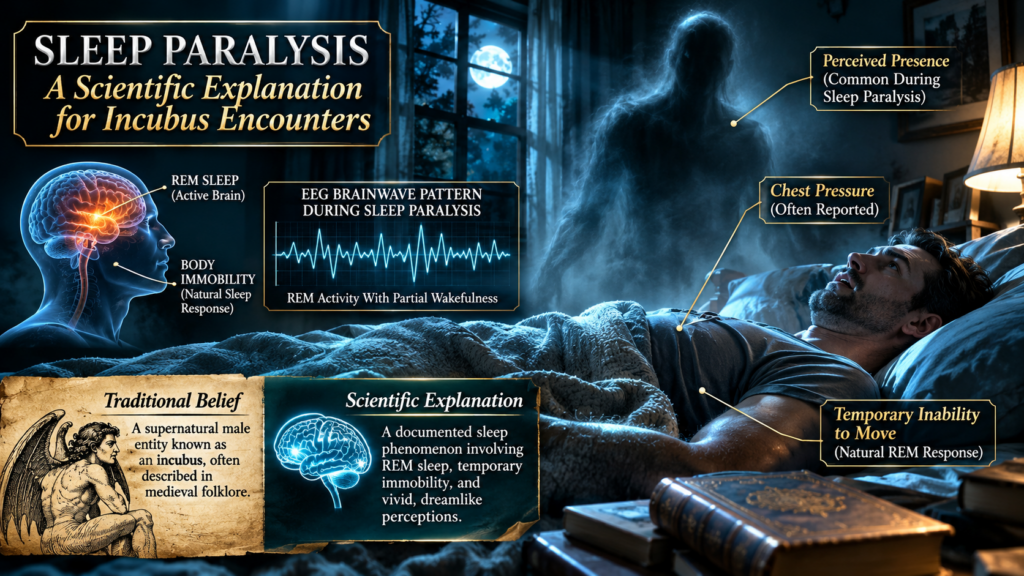
Paranormal literature associates several recurring experiences with alleged incubus encounters. None can independently confirm supernatural activity.
“Recognizing a familiar pattern is not the same as proving what caused it.”
1. Heavy Pressure Against the Chest
One of the oldest characteristics associated with incubus folklore is the sensation of something sitting or pressing against the chest.
People experiencing sleep paralysis sometimes report remarkably similar sensations.
Chest pressure should never automatically be attributed to paranormal activity.
2. Temporary Inability to Move
Some historical accounts describe individuals awakening but being unable to move, speak or call for help.
This experience closely resembles sleep paralysis, which can occur during transitions between sleep and wakefulness.
3. A Mysterious Presence in the Bedroom
Some individuals describe an overwhelming impression that another person or presence is nearby.
Sleep researchers have also documented sensed presence experiences, including situations where individuals perceive someone without clearly seeing them.
4. Vivid Dreams and Unwanted Physical Sensations
Incubus folklore commonly describes disturbing dreams involving physical or intimate contact.
Dream experiences and sleep related sensory perceptions can feel exceptionally realistic.
A vivid or lucid dream alone cannot establish an external presence.
5. Seeing Shadow Figures
Modern paranormal accounts sometimes describe dark silhouettes near beds, bedroom doors or corners.
Dreamlike visual perceptions during awakening may offer an alternative explanation.
6. Sudden Bedroom Chills
Contemporary paranormal accounts sometimes associate unexpected chills with an incubus encounter.
However, cold sensations are nonspecific. Room temperature, airflow and ordinary physical responses should also be considered.
7. Fear Following a Nighttime Experience
Some people awaken feeling frightened, confused or emotionally unsettled.
These feelings deserve compassion. However, the intensity of an experience does not establish its origin.
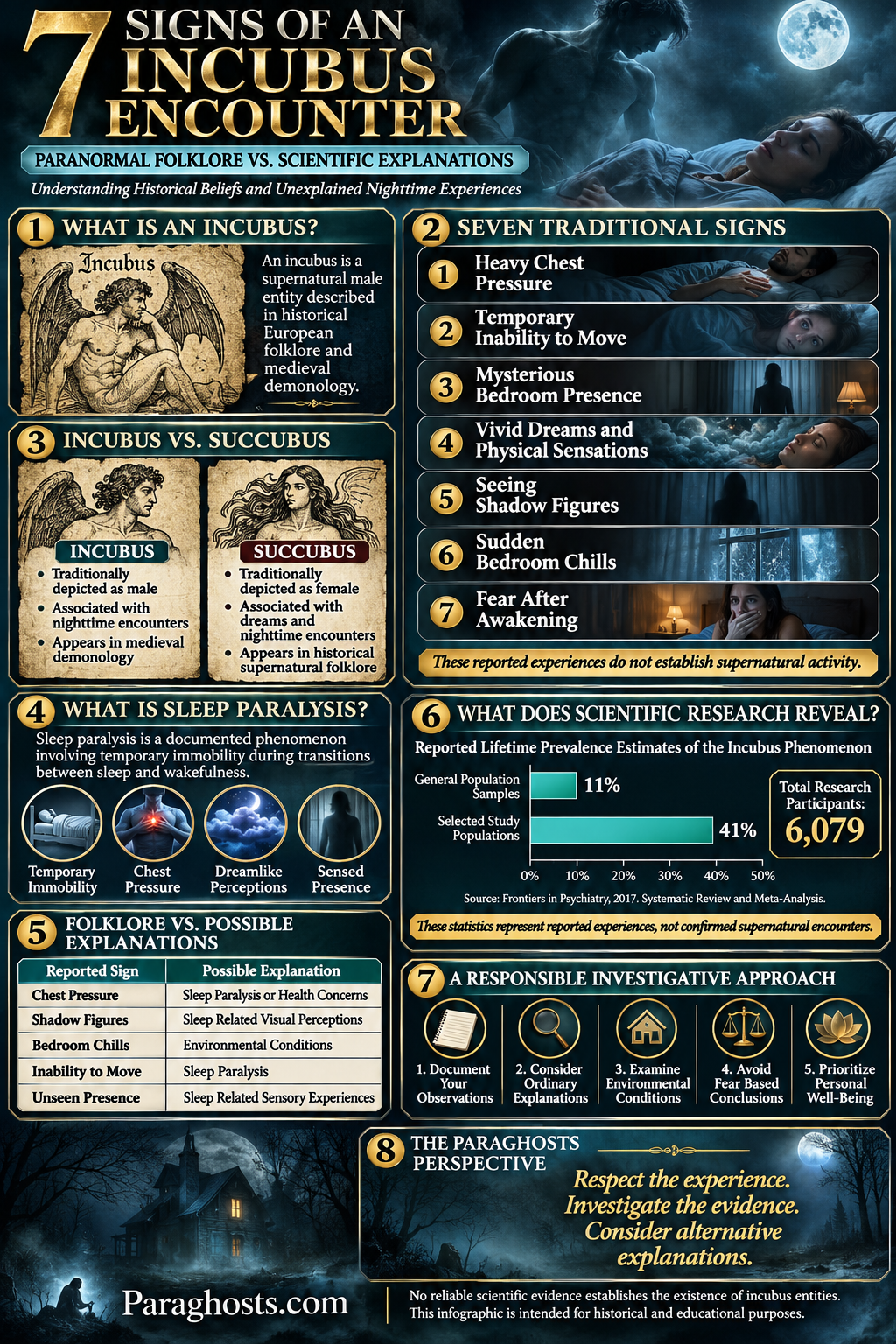
How Do Traditional Incubus Signs Compare With Ordinary Explanations?
Many experiences attributed to an incubus overlap with documented sleep phenomena and ordinary environmental conditions.
“A responsible investigator considers alternative explanations before reaching a conclusion.”
| Reported Experience | Folklore Interpretation | Possible Ordinary Explanation |
|---|---|---|
| Chest pressure | Entity pressing against the body | Sleep paralysis or another health concern |
| Inability to move | Supernatural restraint | Sleep paralysis |
| Bedroom chills | Supernatural presence | Temperature changes or airflow |
| Shadow figures | Bedroom apparition | Sleep related visual perceptions |
| Perceived touch | Physical entity contact | Dreamlike sensory experiences |
| Disturbing dreams | Supernatural visitation | Nightmares or vivid dreams |
| Unseen presence | Invisible entity | Sensed presence during sleep transitions |
This comparison highlights why a folklore checklist cannot reliably identify a supernatural encounter.
What Does Science Say About the Incubus Phenomenon?
Scientific research documents experiences known as the incubus phenomenon.
Researchers use this term to describe certain frightening sleep related experiences, not verified encounters with supernatural beings.
“The experience may feel completely real even when its cause remains misunderstood.”
During REM sleep, most voluntary muscles temporarily become inactive. Occasionally, awareness returns before normal movement resumes.
Dreamlike perceptions can also overlap with wakefulness.
Watch Video: Understanding the Connection Between Incubus Encounters and Sleep Paralysis
The following educational video explores how sleep paralysis can produce experiences similar to the traditional signs of an incubus encounter. It examines chest pressure, temporary immobility, mysterious bedroom presences and historical supernatural interpretations.
What Does Research Reveal About Incubus Experiences?
A 2017 systematic review and meta-analysis published in Frontiers in Psychiatry examined research involving 6,079 participants.
Researchers estimated the following lifetime prevalence rates:
- General population samples: 11%.
- Selected study populations: 41%.
The selected populations included particular patient groups, refugees and students.
Graph: Reported Lifetime Prevalence of the Incubus Phenomenon
General population samples
█████▌ 11%
Selected study populations
████████████████████▌ 41%
Source: Molendijk and colleagues, Frontiers in Psychiatry, 2017.
These figures describe reported sleep experiences.
They do not represent confirmed paranormal encounters, and the selected populations should not be considered representative of everyone.
What Have Other People Reported About These Experiences?
Personal accounts demonstrate how convincing frightening sleep experiences can become.
“Listening respectfully does not require accepting every proposed explanation.”
A 2026 study examining sleep paralysis experiences in New Zealand documented recurring descriptions of fear, shadow figures, physical sensations and limited bodily control.
One participant identified as Aroha explained:
“It felt like someone was holding me down.”
Other participants described experiences that seemed indistinguishable from their waking surroundings.
These documented perspectives help explain why supernatural interpretations can feel personally convincing, even when independent evidence is unavailable.
What Should You Do After an Alleged Incubus Encounter?
A grounded response involves prioritizing personal safety, recording observations and avoiding premature conclusions.
“I prefer careful documentation over conclusions driven by fear.”
Step 1: Record What Happened
Write down the approximate time, sensations, surroundings and whether you were falling asleep or awakening.
Separate direct observations from interpretations.
Step 2: Consider Ordinary Environmental Factors
Check ordinary sources of shadows, airflow, unfamiliar noises and lighting changes.
There is no need to spend the night monitoring your bedroom or attempting to provoke another experience.
Step 3: Avoid Fear Based Interpretations
Be cautious of websites claiming that nightmares, chills or recurring dreams guarantee the presence of a demon.
Such claims lack reliable scientific support.
Step 4: Prioritize Your Well-Being
Speak with a qualified healthcare professional if frightening experiences recur, disrupt sleep or occur while fully awake.
Sudden severe chest pain or significant breathing difficulties require emergency medical attention, not paranormal investigation.
What Are the Biggest Myths About Incubus Encounters?
Many popular incubus claims are based on speculation rather than independently verified evidence.
“An unexplained experience should remain unexplained until sufficient evidence supports a conclusion.”
Myth: Every intimate dream indicates an incubus.
Dream content cannot establish supernatural contact.
Myth: Cold spots confirm an entity.
Temperature changes have numerous ordinary explanations.
Myth: Repeated encounters prove a spiritual attachment.
Recurring experiences do not establish supernatural involvement.
Myth: Paranormal equipment can identify an incubus.
No ghost hunting instrument has been scientifically validated to identify supernatural entities.
What Has Helped Me Approach Paranormal Accounts More Objectively?
The investigative approach I favor separates the reported experience, its proposed explanation and independently verifiable evidence.
“I can respect someone’s experience without claiming to know exactly what caused it.”
Rather than asking which supernatural entity caused an experience, I prefer asking whether enough reliable information exists to establish its origin.
This distinction encourages curiosity without unnecessarily increasing fear.
For paranormal researchers, maintaining that balance is especially important when an individual describes disturbing bedroom experiences.
People Also Ask:
“Good paranormal research begins with better questions.”
What are the first signs of an incubus?
Traditional accounts describe chest pressure, frightening dreams, perceived physical contact and an unseen presence. These experiences are not scientifically established signs of an actual entity.
Can an incubus appear in dreams?
Incubus folklore frequently describes dream encounters. However, dream content cannot establish that a supernatural being is present.
Is an incubus the same as sleep paralysis?
An incubus is a folklore entity. Sleep paralysis is a documented sleep phenomenon that can produce experiences resembling historical incubus descriptions.
Can an incubus appear as a shadow figure?
Modern paranormal stories sometimes describe shadow figures. Sleep related visual perceptions can also produce similar experiences.
Is there scientific evidence that an incubus exists?
No reliable scientific evidence establishes the existence of an incubus as a supernatural being. Research instead documents experiences described as the incubus phenomenon.
Can incubus experiences happen repeatedly?
People can experience recurring frightening sleep phenomena. Repetition alone does not prove supernatural involvement.
Conclusion: Understanding the Signs of an Incubus Without Fear
The traditional signs of an incubus offer a fascinating glimpse into centuries of supernatural folklore and human experiences.
“Curiosity should encourage understanding, not create unnecessary fear.”
Chest pressure, vivid dreams, perceived contact and mysterious bedroom presences have appeared in historical accounts and modern sleep research.
My preferred approach is to remain curious while considering credible alternative explanations.
We can appreciate paranormal history, respect personal experiences and acknowledge uncertainty without treating folklore as established fact.
About the Author
Kevin Mack is the founder of Paraghosts.com, a paranormal investigator, researcher and freelance writer with more than 15 years of experience exploring ghosts, paranormal phenomena and unexplained experiences.
He also writes educational mental wellness content from a non-clinical perspective. His work emphasizes responsible investigation, historical research, critical thinking and respect for individual experiences.
Sources and References
The following historical references, scientific studies, educational resources and medical organizations provide additional information about the signs of an incubus, succubus folklore, sleep paralysis and unexplained nighttime experiences.
1. Encyclopaedia Britannica (1911 Edition): Incubus
A historical reference examining the origins of incubus folklore, medieval demonology and traditional beliefs surrounding supernatural nighttime visitors.
Website: Incubus: Encyclopaedia Britannica Historical Archive
2. Encyclopedia.com: Succubus
Explores the history of succubus folklore, medieval supernatural traditions and the relationship between incubus and succubus beliefs.
Website: Succubus Folklore and History
3. National Library of Medicine: Sleep Paralysis and Folklore
Examines the relationship between sleep paralysis, nightmares, cultural traditions and historical beliefs involving supernatural entities.
Website: Sleep Paralysis and Folklore
4. Frontiers in Psychiatry: Prevalence Rates of the Incubus Phenomenon
A peer-reviewed systematic review and meta-analysis examining the reported prevalence of the incubus phenomenon across different study populations.
Website: Prevalence Rates of the Incubus Phenomenon: A Systematic Review and Meta-Analysis
5. National Health Service (NHS): Sleep Paralysis
Provides educational information about sleep paralysis, temporary immobility, perceived bedroom presences and frightening sensations during sleep transitions.
Website: Understanding Sleep Paralysis
6. Cleveland Clinic: Sleep Paralysis
A medically reviewed educational resource explaining sleep paralysis, REM sleep, sensory experiences and possible contributing factors.
Website: Sleep Paralysis: Symptoms, Causes and Explanations
7. Kōtuitui: New Zealand Journal of Social Sciences Online
A 2026 research study examining personal experiences of sleep paralysis, cultural interpretations, shadow figures, perceived physical sensations and supernatural beliefs.
Website: Phenomenology and Interpretations of Sleep Paralysis
8. American Heart Association: Warning Signs of a Heart Attack
Provides important educational information about chest pressure, breathing difficulties and other potentially serious warning signs that should not be mistaken for paranormal activity.
Website: Warning Signs of a Heart Attack
These references are provided for historical, scientific and educational purposes. While paranormal folklore documents longstanding beliefs involving incubus and succubus entities, scientific research has not established their existence as supernatural beings.
Paranormal Disclaimer: This article discusses historical folklore, personal investigative perspectives and scientific research for educational purposes. Alleged supernatural encounters have not been scientifically established.
Visit Paraghosts.com for More Paranormal Related Content.