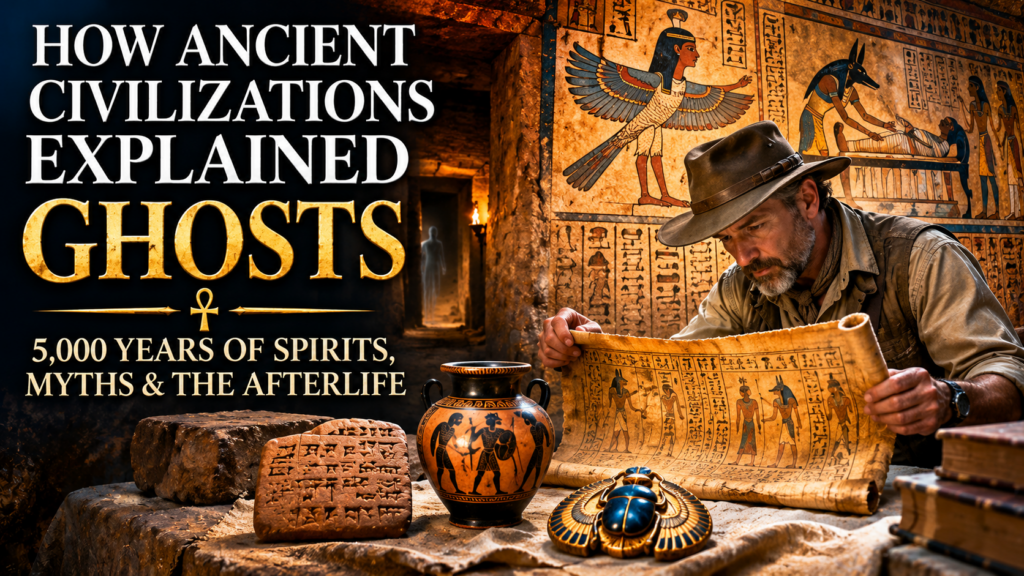
Explore the ancient history of ghosts and discover how six early civilizations explained spirits, restless souls, burial rituals, and life after death.
By Kevin Mack | Paranormal Investigator, Researcher, and Founder of Paraghosts.com | November 24, 2026
Disclaimer: This article is for historical and educational purposes only. It explores ancient ghost beliefs, spiritual traditions, and cultural interpretations of the afterlife. These accounts do not constitute scientific proof of ghosts, paranormal activity, or life after death.
Introduction
Explore the ancient history of ghosts and discover how early civilizations explained spirits, restless souls, burial rituals, and the afterlife.
The ancient history of ghosts reveals how early civilizations tried to understand death, the human spirit, and the possibility of life beyond the physical world.
Long before modern paranormal investigations, people believed that the dead could influence the living.
Ancient societies developed elaborate explanations for what happened after death. Some believed spirits traveled to an underground kingdom.
Others believed souls could return home, visit relatives, or punish those who neglected their burial traditions.
These beliefs influenced religious ceremonies, funeral practices, ancient literature, and the earliest surviving accounts of supernatural encounters.
From the civilizations of Mesopotamia to the temples of ancient Egypt, the concept of ghosts played an important role in human history.
But where did these beliefs begin? Why did ancient people fear certain spirits while honoring others?
To answer these questions, we must explore the historical evidence behind humanity’s earliest documented ghost traditions.
Direct Answer:
What Is the Ancient History of Ghosts?
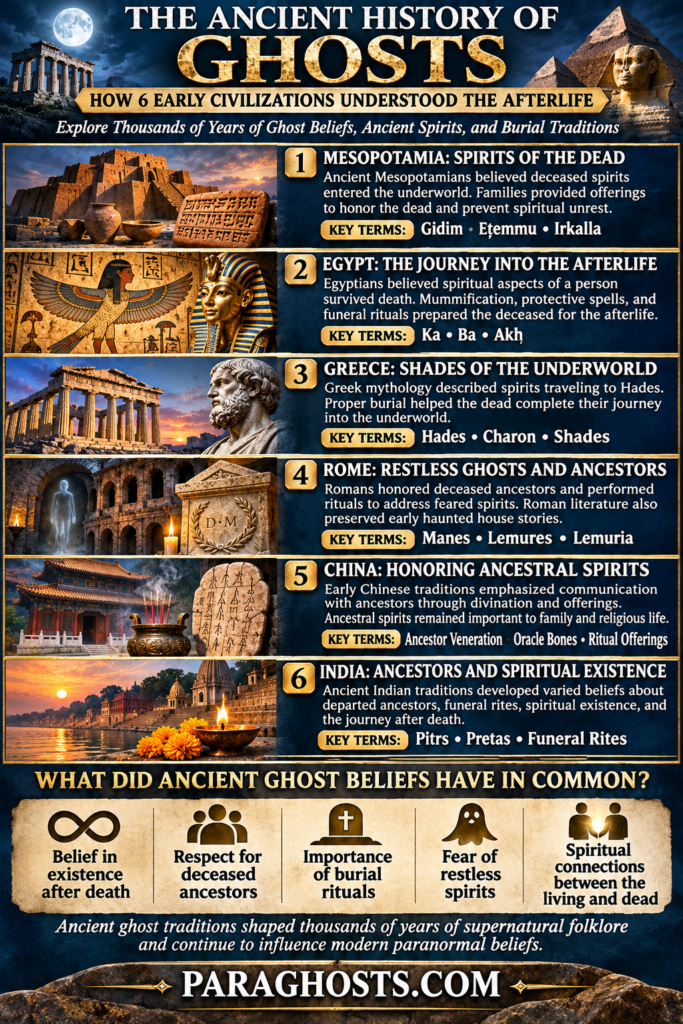
The ancient history of ghosts examines how early civilizations understood spirits and life after death. Ancient Mesopotamians believed the dead could return if families neglected burial rites. Egyptians developed complex beliefs about the soul and its journey after death. Greeks and Romans described spirits that inhabited the underworld or visited the living.
When Did Humans First Begin Believing in Ghosts?
The belief that something survives physical death likely developed long before written history.
Archaeologists have discovered prehistoric burials containing tools, ornaments, pigments, and other objects.
Some of these discoveries suggest that early humans attached symbolic or spiritual meaning to death.
However, burial objects alone cannot prove that prehistoric people believed in ghosts.
They may reflect respect for the deceased, social traditions, or ideas about an afterlife. Their exact meaning often remains uncertain.
The earliest surviving written descriptions of recognizable ghosts come from ancient civilizations that developed writing systems.
Mesopotamian records provide particularly important evidence.
Sumerian and Akkadian texts describe spirits of the dead, the underworld, funeral offerings, and rituals intended to prevent supernatural disturbances.
These records show that ghost beliefs were already well developed thousands of years ago.
They do not establish when humanity first imagined ghosts. They reveal when people began preserving those ideas in writing.
Ghosts in Ancient Mesopotamia: Some of the Earliest Written Beliefs
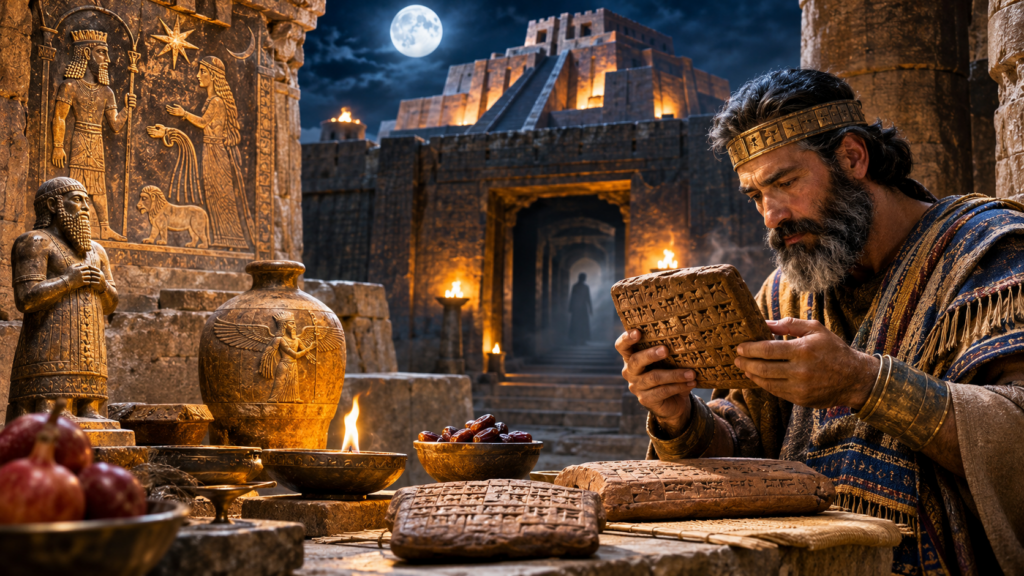
Ancient Mesopotamia occupied much of the region between the Tigris and Euphrates rivers. Its civilizations included the Sumerians, Akkadians, Babylonians, and Assyrians.
These societies produced some of the oldest surviving written accounts of spirits and the afterlife.
The Sumerian and Akkadian Concept of the Ghost
In Sumerian texts, the word gidim referred to a spirit of the dead. Akkadian texts used the term eṭemmu.
These spirits retained an existence after physical death.
Mesopotamians believed that most deceased people entered an underworld. They also believed that the dead continued to depend on their surviving relatives.
Families provided food, water, and commemorative offerings to sustain their ancestors.
A neglected spirit could become restless. Ancient texts sometimes associated these ghosts with sickness, disturbing dreams, and other misfortunes.
These beliefs created a strong connection between family responsibilities and supernatural fears.
The living cared for the dead. In return, they hoped the dead would remain peaceful.
The Mesopotamian Underworld
Mesopotamian mythology described a realm of the dead that people could not ordinarily escape.
One name for this underworld was Irkalla.
Ancient accounts often portrayed it as a dark and difficult place. It was not generally a paradise where every person received eternal happiness.
The goddess Ereshkigal ruled the underworld in several traditions. The god Nergal also became associated with its rule.
The deceased entered this realm regardless of many distinctions that shaped their earthly lives.
This concept differs from later religious traditions that place greater emphasis on separate destinations of eternal reward and punishment.
According to research published by The Metropolitan Museum of Art, ancient Mesopotamians believed that spirits of the dead inhabited a dark underworld ruled by Ereshkigal and Nergal.
Why Mesopotamians Feared Restless Ghosts
Ancient Mesopotamians did not view every ghost as dangerous.
Many spirits were simply deceased family members who needed continued care.
However, people feared ghosts that had received improper burials or inadequate offerings.
Some texts also connected troubling spirits with violent deaths and unresolved circumstances.
Religious specialists performed rituals intended to protect the living and restore order.
These traditions represent an early documented example of a belief that neglected or unsettled dead people could return to trouble the living.
That idea would appear in many later ghost stories.
Ancient Egyptian Ghost Beliefs and the Journey of the Soul
Watch: How Ancient Egyptians Explained the Afterlife
Ancient Egyptian beliefs about death reveal how early civilizations understood the human spirit and the possibility of life after death. The following educational video from TED-Ed explores the Egyptian Book of the Dead and the supernatural challenges that souls were believed to face in the underworld.
Watch Video Below:
Ancient Egypt developed one of history’s most elaborate systems of beliefs about death and the afterlife.
Egyptians believed that death did not necessarily end a person’s existence.
Instead, death began a transformation that required preparation, protection, and divine assistance.
Watch: How Ancient Egyptians Explained the Afterlife
Ancient Egyptian beliefs about death reveal how early civilizations understood the human spirit and the possibility of life after death.
The following educational video from TED-Ed explores the Egyptian Book of the Dead and the supernatural challenges that souls were believed to face in the underworld.
These ancient traditions provide valuable insight into the history of ghosts, spiritual beliefs, and humanity’s fascination with the afterlife.
Video: https://www.youtube.com/watch?v=1yv_MXNYbAo
The Ka, Ba, and Akh
Ancient Egyptian spiritual beliefs included several aspects of a person’s existence.
Three important concepts were the ka, ba, and akh.
The Ka: The Life Force
The ka represented a person’s vital essence. Funeral offerings helped sustain it after death.
Families maintained tombs and provided offerings to support the deceased.
The Ba: The Mobile Aspect of the Person
Egyptians often depicted the ba as a bird with a human head.
The ba could move beyond the tomb. It also needed to reunite with the deceased person’s preserved body.
The Akh: The Transformed Spirit
The akh represented an effective or transformed spiritual existence.
Proper funeral rituals and successful passage through the afterlife helped make this transformation possible.
These concepts show that Egyptians did not understand the human soul as one simple, unchanging entity.
Why Ancient Egyptians Preserved the Dead
Mummification played an important role in Egyptian beliefs about the afterlife.
Egyptians believed the preservation of the body supported the deceased person’s continued existence.
The tomb also provided a protected place for the person’s spiritual elements.
Families placed food, jewelry, protective amulets, and other objects in tombs.
These items reflected practical and religious preparations for life after death.
The Egyptians believed that the deceased could encounter dangers during the journey into the next world.
Protective spells and funeral rituals helped guide the dead through those challenges.
The Book of the Dead and the Afterlife
The Egyptian Book of the Dead was not one fixed book.
It was a collection of funerary spells that developed over time.
These texts offered guidance for navigating the afterlife, overcoming supernatural obstacles, and approaching divine judgment.
One famous scene shows the deceased person’s heart being weighed against the feather associated with Ma’at, the principle of truth and cosmic order.
The judgment determined whether the deceased could continue toward a blessed afterlife.
These beliefs demonstrate how closely ancient Egyptian religion connected moral conduct, spiritual survival, and funeral preparation.
Did Ancient Egyptians Believe Ghosts Could Return?
Egyptian traditions also included accounts of deceased individuals communicating with the living.
Some surviving letters addressed to the dead ask deceased relatives for assistance or relief from difficulties.
Such documents suggest that some Egyptians believed their ancestors could influence events beyond the tomb.
However, an Egyptian ba or akh should not automatically be equated with the modern idea of a haunted house ghost.
Ancient Egyptian spiritual categories were more complex.
Ghosts in Ancient Greece: Spirits, Shadows, and the Underworld
Ancient Greek mythology provides some of the most influential ghost stories in Western literature.
Greek writers described spirits that continued to exist after death.
These spirits often appeared as shades, or shadowlike forms of deceased individuals.
The Greek Underworld and the River Styx
The Greeks believed that many deceased people entered the realm of Hades.
In mythology, the dead encountered boundaries separating the living world from the underworld.
The river Styx became one of the most recognized symbols of this separation.
Charon, the mythological ferryman, transported the dead across an underworld river in later Greek traditions.
Burial customs sometimes included coins associated with this journey.
However, the practice varied by time and place. Not every Greek burial contained a coin.
Ghosts in Homer’s Odyssey
One of the most famous ancient Greek encounters with the dead appears in Homer’s Odyssey.
Odysseus travels to the edge of the underworld and performs rituals that allow him to communicate with deceased spirits.
He encounters figures from his past and seeks guidance from the prophet Tiresias.
The episode reveals an important ancient belief.
The dead might retain memories, identities, and knowledge that the living could seek.
The scene also demonstrates how offerings and ritual actions could establish contact between the two worlds in Greek mythology.
The Ghost of Patroclus in the Iliad
Another significant ghost story appears in Homer’s Iliad.
After Patroclus dies, his spirit appears to Achilles in a dream.
The ghost asks Achilles to complete the funeral rites so he can enter the realm of the dead.
This account connects proper burial with spiritual peace.
It also illustrates the ancient fear that an unburied person might remain unable to complete the journey after death.
Why Greeks Feared Improper Burials
Greek funeral traditions emphasized respect for deceased relatives.
People believed that neglecting burial obligations could offend religious customs and disturb the relationship between the living and the dead.
Some Greek stories portrayed restless spirits seeking recognition, burial, or justice.
These themes later influenced European folklore and supernatural literature.
Ancient Roman Ghost Beliefs and Haunted Houses
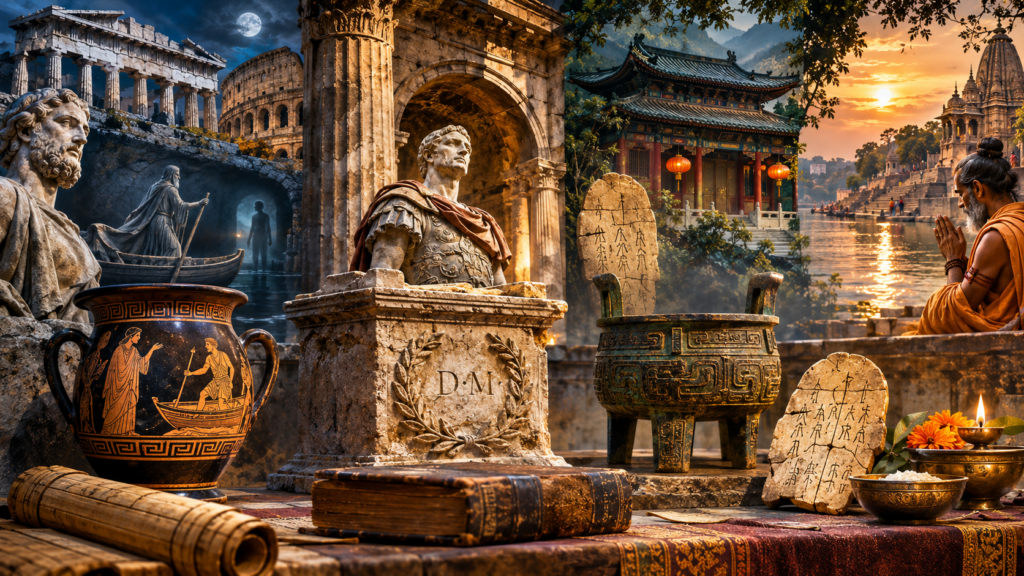
The Romans inherited and adapted many Greek ideas about the afterlife.
However, Roman religion also developed distinctive traditions involving ancestors, restless spirits, and household protection.
The Manes: Spirits of Deceased Ancestors
Romans used the term Manes for the spirits of the dead, especially in religious and funerary contexts.
Families honored deceased relatives through ceremonies and offerings.
They believed that maintaining proper relationships with the dead supported household and community well being.
Roman funerary inscriptions frequently invoked the divine spirits of the deceased.
The Lemures: Restless Spirits
Roman traditions also described lemures.
These spirits were often associated with the restless or potentially threatening dead.
Some Romans performed household rituals intended to prevent unwelcome supernatural disturbances.
The festival of Lemuria took place on May 9, 11, and 13.
The Roman poet Ovid described a ritual involving black beans and actions intended to drive spirits away.
The Parentalia Festival
Romans also celebrated the Parentalia to honor deceased family members.
During this observance, families visited graves and made offerings.
The festival reinforced the importance of remembrance and family obligations.
Together, Lemuria and Parentalia demonstrate two different responses to the dead.
Some spirits deserved honor and remembrance.
Others inspired fear and protective rituals.
One of the Earliest Famous Haunted House Stories
An especially important ancient ghost account appears in a letter written by the Roman author Pliny the Younger.
Pliny described a supposedly haunted house in Athens.
According to the story, residents heard mysterious noises at night.
A frightening apparition appeared as an elderly man carrying chains.
The philosopher Athenodorus eventually rented the house and witnessed the figure.
He followed the apparition to a location in the courtyard.
After the site was excavated, workers reportedly discovered human remains.
The remains received a proper burial, and the haunting ended.
The account survives in Pliny’s Letters, Book 7, Letter 27.
This is one of the earliest famous literary examples of a haunted house story.
It contains several features familiar to modern paranormal enthusiasts.
A mysterious apparition, unexplained sounds, a troubled location, and an unresolved burial all play central roles.
However, Pliny’s letter does not establish that the haunting actually occurred. It documents a supernatural story circulating in the Roman world.
Ancient Chinese Ghost Beliefs and Ancestor Traditions
Ancient Chinese traditions also developed complex ideas about deceased ancestors and the spiritual world.
Beliefs differed across historical periods, regions, and religious traditions.
One important concept involved continued relationships between living families and deceased relatives.
Ancestor Veneration in Early China
During the Shang dynasty, rulers performed ceremonies involving deceased royal ancestors.
Oracle bone inscriptions document questions directed toward spiritual powers and ancestors.
These inscriptions provide important evidence for early Chinese religious practices.
Royal ancestors were believed to possess influence over matters affecting the living.
Divination and ritual offerings helped maintain relationships with these powers.
This practice was not identical to the modern idea of ghost hunting.
It reflected a wider religious understanding of family, political authority, and spiritual continuity.
The Hun and Po Concepts
Later Chinese philosophical and religious traditions discussed aspects of the person using the terms hun and po.
These concepts were sometimes associated with different dimensions of spiritual existence.
However, their meanings changed across historical periods and traditions.
It would be misleading to suggest that every ancient Chinese community shared one fixed theory of the soul.
How Chinese Ghost Traditions Developed
Over time, Chinese religious traditions included stories about hungry ghosts, neglected ancestors, and spirits seeking assistance.
Buddhist, Daoist, and local religious beliefs shaped many of these accounts.
Later festivals and rituals emphasized offerings, remembrance, and compassion toward suffering spirits.
The broader historical pattern resembles beliefs found elsewhere.
The living maintained responsibilities toward the dead.
Ancient Indian Beliefs About Spirits and the Afterlife
Ancient India developed diverse religious and philosophical explanations for death.
Early Vedic traditions, later Hindu traditions, and other Indian religious movements did not all share identical beliefs.
Some traditions emphasized deceased ancestors and the importance of funeral rites.
Others developed increasingly elaborate teachings about karma, rebirth, and liberation.
The Pitrs: Honored Ancestors
The Sanskrit term pitṛ refers to a father or ancestor.
In religious contexts, the Pitrs represent departed ancestors who receive remembrance and ritual offerings.
Families performed ceremonies intended to honor deceased relatives and maintain continuity between generations.
Pretas and Restless Spirits
The term preta has a long history in Indian religious traditions.
Its meanings and associated beliefs developed over time.
In some Hindu traditions, it refers to the deceased in a transitional condition.
In Buddhist cosmology, pretas are often depicted as hungry beings who experience suffering.
These concepts should not be treated as identical to Western ghosts.
They belong to different religious systems with their own explanations of death and spiritual existence.
Why Did Ancient Civilizations Believe in Ghosts?
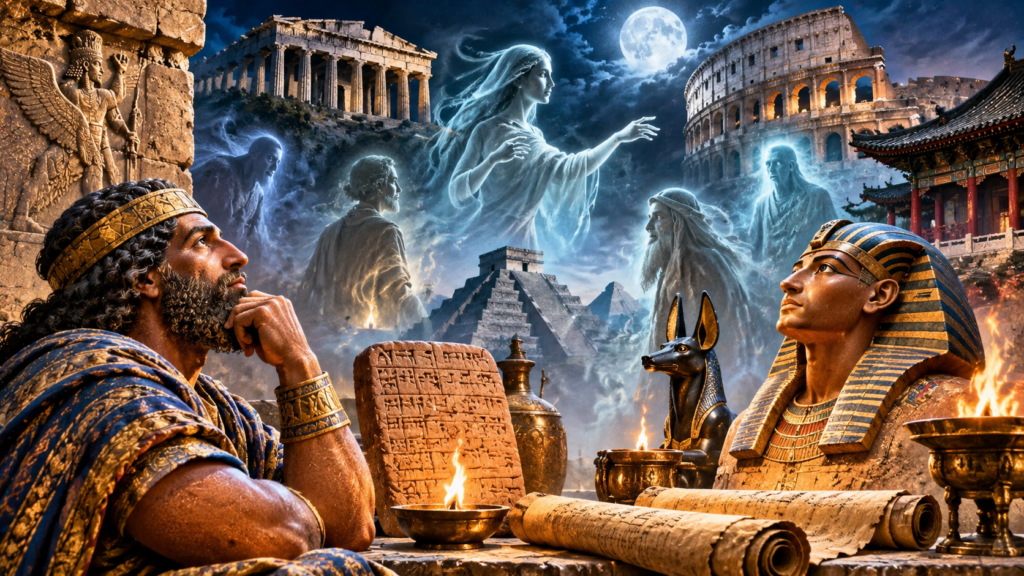
Despite major cultural differences, ancient ghost beliefs often addressed similar human concerns.
1. The Mystery of Death
Death created questions that people could not answer through direct observation.
Where did a person’s identity go?
Could consciousness survive the body?
Would loved ones ever meet again?
Religious and supernatural explanations helped communities respond to these uncertainties.
2. Dreams About Deceased Loved Ones
People sometimes dream about relatives who have died.
Such experiences can feel vivid and emotionally meaningful.
Ancient communities may have interpreted some dreams as visits or messages from the dead.
However, historians cannot assume that every ancient ghost belief originated from dreams.
3. Unexplained Experiences
Unusual sounds, shadows, illness, and unexpected events sometimes received supernatural explanations.
Without modern scientific instruments or medical knowledge, ancient societies interpreted events through the religious frameworks available to them.
This does not mean every ancient person accepted every supernatural claim.
Beliefs and skepticism varied within societies.
4. Respect for Ancestors
Many cultures considered the deceased an important part of family identity.
Honoring ancestors reinforced social responsibilities and family connections.
Ghost beliefs sometimes encouraged people to maintain burial sites and remember previous generations.
5. Fear of Improper Burial
Several ancient traditions connected improper burial with spiritual unrest.
Mesopotamian texts describe neglected ghosts.
Greek literature depicts deceased individuals requesting funeral rites.
Roman ghost stories sometimes connect hauntings with unburied remains.
This recurring theme helped shape later ideas about restless spirits.
How Ancient Ghost Beliefs Differed Across Civilizations
| Civilization | Important Spiritual Concept | Common Afterlife Theme |
|---|---|---|
| Mesopotamia | Gidim and eṭemmu | Ghosts in the underworld depended on offerings |
| Ancient Egypt | Ka, ba, and akh | Spiritual transformation and continued existence |
| Ancient Greece | Shades of the dead | Journey to Hades and importance of burial |
| Ancient Rome | Manes and lemures | Ancestor remembrance and restless ghosts |
| Ancient China | Ancestral spirits | Continuing relationships with deceased ancestors |
| Ancient India | Pitrs and pretas | Ancestor rites and varied conditions after death |
These traditions did not develop into one universal belief system.
Each civilization created explanations influenced by its religion, environment, history, and social structure.
Yet many shared the belief that death did not necessarily end a person’s relationship with the living.
Did Ancient People Actually See Ghosts?
Ancient literature contains numerous descriptions of apparitions and encounters with deceased individuals.
Some accounts describe spirits appearing in dreams.
Others portray ghosts delivering warnings, requesting burial, or revealing information.
These writings provide evidence that ancient people told stories about supernatural encounters.
They do not provide independently verified evidence that spirits physically appeared.
Historians study these records to understand ancient beliefs, experiences, and cultural traditions.
Modern paranormal investigators may find the accounts fascinating. However, they must distinguish between a historical report and proof of a supernatural event.
This distinction is essential when researching the ancient history of ghosts.
How Ancient Ghost Beliefs Influenced Modern Paranormal Traditions
Many themes from ancient ghost stories remain familiar today.
Haunted Houses
The Roman story of Athenodorus features a spirit associated with a particular building.
Modern haunted house reports often describe similar patterns.
Spirits Seeking Justice
Ancient literature sometimes depicts deceased individuals who cannot rest because of unfinished obligations.
Modern ghost stories frequently include comparable themes.
Apparitions of Deceased Relatives
Ancient cultures recorded beliefs that departed family members could communicate with the living.
Similar reports appear in contemporary paranormal literature.
Burial Grounds and Haunted Locations
Many ancient societies considered burial places spiritually significant.
Modern legends also frequently associate cemeteries, tombs, and historical locations with ghost activity.
Rituals for Spiritual Protection
Ancient people used offerings, prayers, and ceremonies to address feared spirits.
Protective rituals remain part of various religious and cultural traditions today.
These similarities show the long history of supernatural storytelling.
They do not necessarily prove direct cultural transmission between every ancient and modern belief.
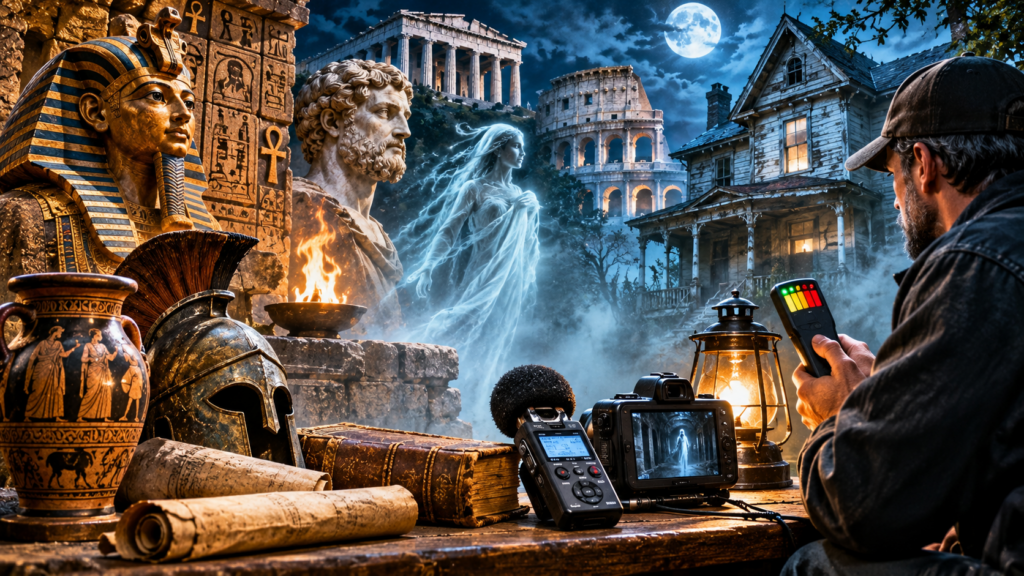
What Can Modern Paranormal Investigators Learn From Ancient Ghost History?
The ancient history of ghosts offers several valuable lessons for contemporary paranormal research.
First, reports of supernatural encounters existed long before cameras, electronic voice recorders, or electromagnetic field detectors.
Second, culture strongly influences how people interpret unusual experiences.
A Mesopotamian family might have blamed a disturbance on a neglected ancestor.
An ancient Greek writer might have described a shade seeking burial.
A modern witness might interpret a similar experience as a haunting.
The underlying experience could sound familiar. However, the explanation may differ dramatically.
Third, historical context matters.
Investigators studying allegedly haunted locations should research the traditions of the people who lived there.
Understanding burial customs, religious practices, and local folklore can help distinguish historical beliefs from later legends.
Finally, researchers should preserve the difference between documented history and supernatural interpretation.
An ancient text can confirm that people believed in ghosts.
It cannot independently establish that ghosts exist.
Frequently Asked Questions About the Ancient History of Ghosts
What civilization first believed in ghosts?
No civilization can be conclusively identified as the first to believe in ghosts. Ancient Mesopotamia provides some of the earliest surviving written descriptions of recognizable spirits of the dead. However, ghost beliefs may be much older than writing.
What is the oldest known ghost story?
There is no universally agreed oldest ghost story. Mesopotamian literature contains very early accounts of spirits and the underworld. Pliny the Younger’s account of a haunted house in Athens is one of the most famous surviving ancient haunted house stories.
Did ancient Egyptians believe in ghosts?
Yes. Ancient Egyptians believed that aspects of a person could survive death. Their spiritual concepts included the ka, ba, and akh. Some Egyptian writings also describe communication between deceased individuals and the living.
Why did ancient Greeks fear ghosts?
Some ancient Greek stories associated restless spirits with improper burial, violent death, or unfinished obligations. Greek religious practices emphasized respectful funeral rites and the deceased person’s passage into the underworld.
Did ancient Romans believe houses could be haunted?
Yes. Roman literature includes accounts of haunted buildings and supernatural apparitions. Pliny the Younger’s famous letter describes a ghost that reportedly appeared in an Athenian house.
What did ancient civilizations believe happened after death?
Beliefs varied widely. Mesopotamians described an underworld inhabited by spirits. Egyptians emphasized spiritual transformation and judgment. Greeks described the realm of Hades. Other cultures developed traditions involving ancestors, rebirth, and continued spiritual relationships.
Are modern ghost stories based on ancient beliefs?
Some modern ghost story themes resemble ancient traditions. These include restless spirits, haunted houses, apparitions, and the importance of proper burial. However, historians must examine individual traditions before claiming direct historical connections.
Conclusion: Why the Ancient History of Ghosts Still Matters
The ancient history of ghosts reveals something important about human civilization.
For thousands of years, people have questioned what happens after death.
Ancient Mesopotamians honored spirits who depended on the living. Egyptians prepared their deceased relatives for spiritual transformation.
Greeks described shades traveling through the underworld. Romans developed traditions involving both honored ancestors and frightening apparitions.
Other civilizations created their own explanations for the relationship between the living and the dead.
These beliefs shaped religious practices, funeral customs, historical literature, and supernatural folklore.
Today, paranormal investigators continue exploring many of the same questions.
Can consciousness survive physical death? Can deceased individuals communicate with the living? Are some locations connected to unexplained spiritual experiences?
Ancient texts cannot provide definitive answers to these questions.
However, they demonstrate that humanity’s fascination with ghosts has endured for thousands of years.
Understanding that history helps us appreciate the cultural origins of modern paranormal beliefs while maintaining a careful distinction between tradition, testimony, and verified evidence.
About the Author
Kevin Mack is a paranormal investigator, researcher, freelance writer, and founder of Paraghosts.com. With more than 15 years of experience exploring paranormal phenomena, he researches ghost sightings, historical hauntings, supernatural folklore, and the history of paranormal investigation. His work combines historical research, documented accounts, and a practical approach to examining unexplained experiences.
Disclaimer: The information presented in this article is based on historical records, ancient religious traditions, and cultural folklore. Paraghosts.com does not claim that these accounts prove the existence of ghosts or an afterlife. Readers are encouraged to approach paranormal claims with an open mind, critical thinking, and independent research.
Sources and References
1. The Metropolitan Museum of Art: Mesopotamian Deities
Explores ancient Mesopotamian religious beliefs, spirits of the dead, supernatural entities, and the underworld ruled by Ereshkigal and Nergal.
Website: The Metropolitan Museum of Art – Mesopotamian Deities
2. The British Museum: Hieroglyphs and Ancient Egyptian Beliefs
Provides historical information about Egyptian funeral rituals, spiritual beliefs, the ka, ba, and akh, and the judgment of the deceased in the afterlife.
Website: The British Museum – Unlocking Ancient Egypt
3. Yale University Peabody Museum: Egyptian Book of the Dead
Examines ancient Egyptian funerary texts, protective spells, burial traditions, and religious beliefs surrounding the journey into the afterlife.
Website: Yale University – Egyptian Book of the Dead
4. Oxford University Press: Ancestor Worship
Provides scholarly information about ancient Chinese ancestral spirits, religious ceremonies, ritual offerings, and the historical development of ghost traditions.
Website: Oxford University Press – Ancestor Worship
5. Cambridge University Press: The Origins of Chinese Ancestral Traditions
Examines archaeological evidence surrounding ancient Chinese ancestor worship, spiritual traditions, and religious practices dating back to the Neolithic period.
Website: Cambridge University Press – Who Were the Ancestors?