Author: Kevin Mack, Paranormal Researcher and Cryptid Investigation Writer
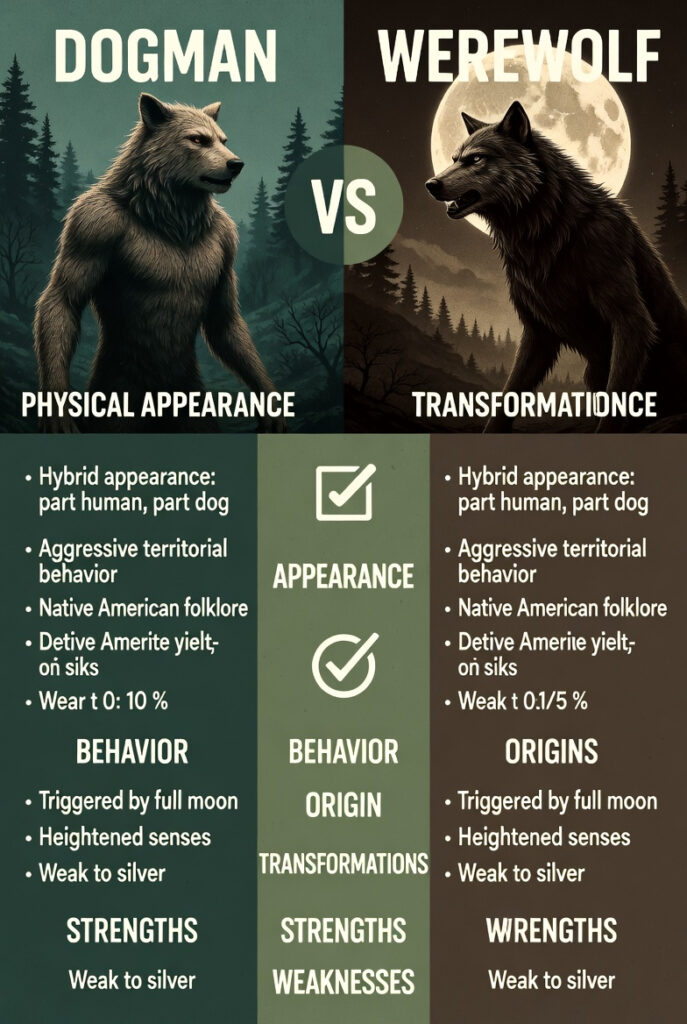
The main difference between Dogman and Werewolf legends is transformation. A Werewolf is typically a human who transforms into a wolf-like creature, while Dogman is believed to be a permanent upright canine cryptid reported in modern sightings. Both share similarities such as intelligence, bipedal movement, and terrifying encounters with witnesses.
Contents
- Dogman vs Werewolf: Differences and Similarities Explained
- What Is the Dogman?
- What Is a Werewolf?
- Key Differences Between Dogman and Werewolf
- Similarities Between Dogman and Werewolf
- Why People Confuse Dogman and Werewolves
- Are Dogman Sightings Modern Werewolf Legends?
- Online Theories
- Quick Comparison Summary
- People Also Ask
- Final Thoughts
- Reference
Dogman vs Werewolf: Differences and Similarities Explained
Dogman vs Werewolf differences and similarities explained in simple terms, including origins, behavior, sightings, and how these mysterious creatures compare in folklore and modern cryptid encounters.
Many people confuse the Dogman and the Werewolf because both creatures appear as terrifying wolf like humanoids. They walk upright. They are covered in fur. Witnesses often describe glowing eyes and intense aggression.
But when you look deeper, these two entities come from completely different origins. One belongs mostly to folklore and mythology. The other comes from modern cryptid sightings reported by real witnesses across North America.
This guide breaks down the Dogman vs Werewolf differences and similarities using eyewitness reports, historical legends, and paranormal research discussions often shared within the Reddit cryptid community.
What Is the Dogman?

The Dogman is considered a modern cryptid rather than a mythical curse or supernatural transformation.
Most reports describe Dogman as:
- A large upright canine creature
- Standing between 6 and 9 feet tall
- Having a muscular human shaped body
- Possessing a wolf or German Shepherd like head
- Moving on two legs but capable of running on all fours
- Showing intelligence and awareness of humans
The most famous sightings come from Michigan, Wisconsin, Louisiana, and parts of the southern United States. Witnesses often claim the creature watches silently before disappearing into wooded areas.
Unlike Werewolves, Dogman sightings usually involve a creature that already exists in its final form. There is no transformation story connected to most encounters.
Many witnesses insist the creature behaves like an undiscovered predator rather than a cursed human.
What Is a Werewolf?

The Werewolf originates from ancient European folklore and mythology.
A Werewolf is traditionally described as:
- A human who transforms into a wolf creature
- Transformation triggered by a full moon
- Connected to curses, magic, or infection
- Often losing human control during transformation
- Returning to human form afterward
Werewolf legends date back thousands of years. Stories appear in French, German, Greek, and Eastern European traditions.
In folklore, transformation often happens due to:
- A supernatural curse
- Witchcraft rituals
- Being bitten by another Werewolf
- Punishment for immoral behavior
Unlike Dogman encounters, Werewolves exist mainly within mythological storytelling rather than consistent modern eyewitness reports.
Key Differences Between Dogman and Werewolf
1. Origin
Dogman
- Modern cryptid phenomenon
- Reported through eyewitness encounters
- Linked to wilderness sightings
Werewolf
- Ancient folklore creature
- Rooted in superstition and mythology
- Associated with magic and curses
2. Transformation Ability
This is the biggest difference.
Dogman
- Permanent creature form
- No human transformation reported
- Appears as a natural being
Werewolf
- Human transforms into wolf form
- Transformation often tied to lunar cycles
- Returns to human state afterward
3. Behavior Toward Humans
Dogman
- Often observed watching humans
- Sometimes intimidating but rarely attacking
- Displays intelligence and curiosity
Werewolf
- Traditionally aggressive
- Portrayed as violent during transformation
- Driven by uncontrollable instinct
4. Physical Appearance
Both share similarities, which causes confusion.
Dogman descriptions usually include:
- Digitigrade legs similar to a canine
- Broad shoulders
- Long snout
- Pointed ears
- Massive height
Werewolves vary depending on legend or media portrayal. Some appear as giant wolves, while others resemble human wolf hybrids.
Similarities Between Dogman and Werewolf
Despite their differences, there are strong overlaps.
Upright Walking
Both creatures are commonly described walking on two legs. This human like movement creates intense fear during encounters.
Canine Features
Witnesses and legends describe:
- Fur covered bodies
- Sharp teeth
- Clawed hands
- Wolf shaped heads
Nighttime Encounters
Most sightings and stories occur at night or near isolated forests.
Fear Response in Witnesses
People reporting encounters often describe overwhelming dread, paralysis, or the feeling of being watched.
This psychological reaction appears in both folklore accounts and modern cryptid reports.
Why People Confuse Dogman and Werewolves
Modern media plays a major role.
Movies, television, and internet stories blend folklore with cryptid reports. When someone encounters an unknown upright canine creature, the brain often labels it using familiar mythology.
Reddit discussions frequently show witnesses asking:
“Did I see a Werewolf or a Dogman?”
In many cases, encounters lack any transformation event. That detail usually points toward Dogman rather than Werewolf lore.
Are Dogman Sightings Modern Werewolf Legends?
Some researchers believe Dogman sightings may represent a modern evolution of Werewolf mythology.
Possible explanations include:
- Misidentified animals
- Psychological fear responses
- Cultural storytelling carried into modern times
- Unknown or undiscovered species
- Paranormal or interdimensional theories
The debate continues across paranormal and cryptid communities.
Online Theories
Common theories discussed online include:
- Dogman as an undiscovered primate canine hybrid
- Government experiments or escaped biological entities
- Interdimensional beings appearing temporarily
- Ancient predators surviving in remote forests
- Spiritual or supernatural guardians tied to land
No theory has been scientifically confirmed, but eyewitness consistency keeps the topic alive.
Quick Comparison Summary
Dogman
- Modern cryptid
- Permanent canine humanoid
- North American sightings
- No transformation
- Observational behavior
Werewolf
- Mythological creature
- Human transformation
- Ancient European origins
- Moon related curse
- Violent folklore reputation
People Also Ask
What is the difference between Dogman and a Werewolf?
The main difference between Dogman and a Werewolf is transformation. A Werewolf is traditionally a human who changes into a wolf-like creature, usually during a full moon. Dogman, on the other hand, is believed to be a permanent upright canine cryptid reported in modern sightings, especially in North America. Witnesses describe Dogman as a tall humanoid wolf creature that already exists in its final form rather than transforming from a human.
Is Dogman a real creature or just a legend?
Dogman is considered a cryptid, which means it is a creature reported in eyewitness encounters but not officially proven by science. Many sightings have been reported in places like Michigan, Wisconsin, Louisiana, and other wooded regions of the United States. Some researchers believe Dogman could be an undiscovered species, while others think the sightings may come from misidentifications or folklore.
Are Dogman and Werewolves the same creature?
Most researchers believe Dogman and Werewolves are different. Werewolves come from ancient European mythology involving human transformation into wolves. Dogman sightings are modern reports of a large upright canine creature that does not appear to transform from a human. The similar appearance is why people often confuse the two.
Where are Dogman sightings most common?
Dogman sightings are most commonly reported in North America. Michigan is one of the most famous locations due to the long history of sightings known as the Michigan Dogman legend. Reports have also surfaced in Wisconsin, Louisiana, Kentucky, and other heavily wooded areas.
Can a Werewolf stay permanently transformed?
In traditional folklore, Werewolves do not stay permanently transformed. The transformation usually happens during a full moon and ends once the moon cycle passes. However, some modern movies and stories portray Werewolves as being able to remain in wolf form longer or even permanently, depending on the story.
Why do people confuse Dogman with Werewolves?
People often confuse Dogman with Werewolves because both are described as wolf-like humanoid creatures that walk on two legs. Both creatures also have sharp teeth, glowing eyes, and intimidating appearances. The major difference is that Werewolves originate from folklore about human transformation, while Dogman sightings come from modern eyewitness reports of a creature that appears to already exist in that form.
Final Thoughts
The discussion around Dogman vs Werewolf differences and similarities shows how mythology and modern encounters often overlap.
Werewolves belong largely to legend and symbolic storytelling about humanity’s darker instincts. Dogman exists within ongoing eyewitness reports that continue today.
Whether these creatures are misunderstood animals, psychological experiences, or something truly unexplained remains open to interpretation.
One thing is certain. Reports of upright wolf like beings continue to surface across generations, keeping both Dogman and Werewolf mysteries alive in paranormal discussions worldwide.
Watch a Documentary About the Dogman and Werewolf Below
The following documentary explores real eyewitness accounts, historical reports, and cryptid research connected to the Dogman phenomenon. It provides helpful background when comparing dogman sightings to traditional werewolf legends.
Dawn of the Dogman
About the Author
Kevin Mack is a paranormal researcher and cryptid investigation writer who explores unexplained phenomena, hauntings, and mysterious creatures reported around the world.
He is the founder of Paraghosts.com, a blog dedicated to documenting paranormal encounters, ghost investigations, and cryptid sightings.
Kevin’s work focuses on analyzing eyewitness reports, folklore, and modern paranormal research to help readers better understand the mysteries behind the supernatural. 👻
Reference
- Encyclopedia Britannica – Paranormal
https://www.britannica.com/topic/paranormal
Reference context:
The term paranormal refers to unusual events or experiences that appear supernatural or outside the explanations accepted by modern science.