Contents
- What Is 3I/ATLAS Interstellar Comet and Where Did It Come From? | Mysterious Visitor from Beyond Our Solar System
- Introduction: A Visitor from Beyond the Stars
- What Is 3I/ATLAS?
- How 3I/ATLAS Was Discovered
- The Journey Through the Solar System
- What Scientists Learned from 3I/ATLAS
- Where Did 3I/ATLAS Come From?
- Comparing 3I/ATLAS to Other Interstellar Visitors
- The Importance of Interstellar Comets
- The Mystery That Remains
- Conclusion: A Cosmic Messenger from the Unknown
- References
What Is 3I/ATLAS Interstellar Comet and Where Did It Come From? | Mysterious Visitor from Beyond Our Solar System
Discover the mystery behind 3I/ATLAS, the rare interstellar comet that traveled from beyond our solar system. Learn where it came from, what makes it unique, and how it compares to other interstellar visitors like ‘Oumuamua.
Introduction: A Visitor from Beyond the Stars
Every once in a while, something extraordinary drifts into our solar system. It reminds us that space is alive with movement and mystery.
In 2024, astronomers detected a faint traveler that had never been seen before. It was moving too fast, too freely, and it didn’t belong here.
This visitor became known as 3I/ATLAS, the third confirmed interstellar comet to ever enter our solar system.
Unlike ordinary comets that orbit the Sun, 3I/ATLAS came from deep interstellar space. It was a cosmic messenger carrying the secrets of another star system.
Scientists believe it holds clues to the formation of other worlds far beyond our reach.
In this article, we’ll explore what 3I/ATLAS is, how it was discovered, and where this mysterious object might have come from.
What Is 3I/ATLAS?
The Meaning Behind Its Name
The name 3I/ATLAS is both technical and symbolic.
The “3I” stands for the third interstellar object ever found.
The “ATLAS” part refers to the Asteroid Terrestrial-impact Last Alert System, a telescope network that scans the skies for near-Earth objects.
This system is designed to detect potential threats, but instead, it found something far more mysterious.
Physical Description and Composition
From early observations, astronomers determined that 3I/ATLAS was a small icy body, possibly several hundred meters across.
It showed the familiar traits of a comet, such as a faint glowing tail made of vaporized gas and dust.
The color appeared slightly greenish, which often indicates the presence of carbon molecules reacting with sunlight.
Its brightness and rapid movement through the sky caught attention almost immediately.
As telescopes tracked it, they confirmed it was not bound by the Sun’s gravity.
This meant it was on a hyperbolic trajectory, proving it came from another star system.
Why It’s Classified as Interstellar
An object is considered interstellar when it does not originate from our solar system.
3I/ATLAS traveled at such an incredible speed that it could never have formed near our Sun.
Instead, it was likely ejected from its home system long ago, wandering through the Milky Way until it crossed our path.
How 3I/ATLAS Was Discovered
The Moment of Detection
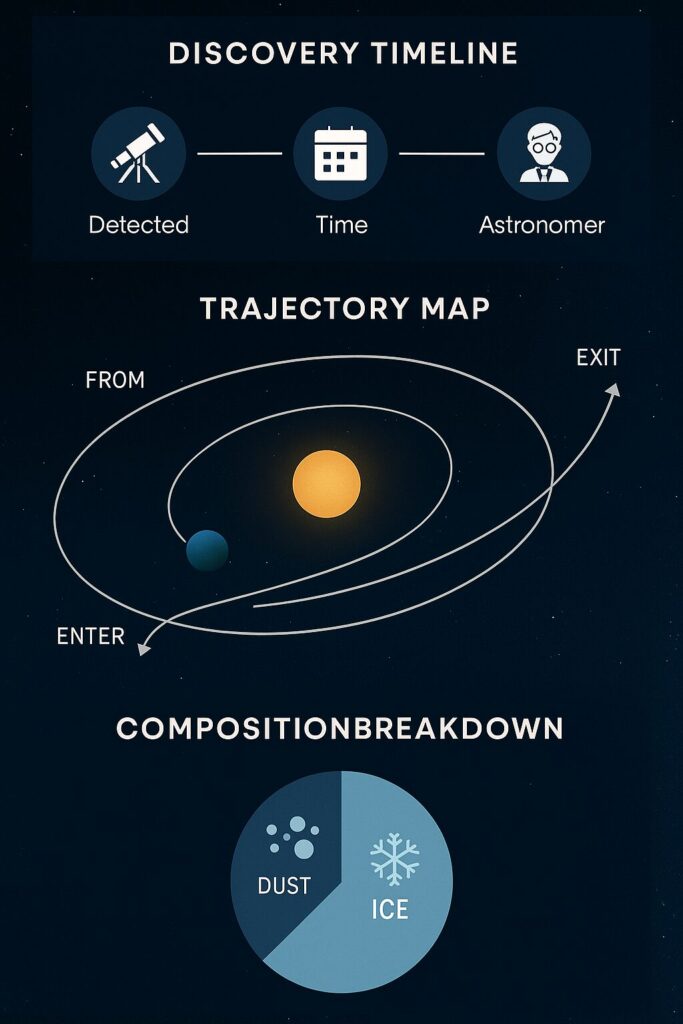
In April 2024, the ATLAS telescope in Hawaii picked up a faint moving point of light.
Astronomers initially thought it was a standard comet, but within days, they noticed something unusual about its orbit.
The path did not loop around the Sun like typical comets. Instead, it came in at an angle that clearly showed it was just passing through.
Confirming Its Interstellar Nature
As data poured in from observatories around the world, experts realized they were witnessing a new interstellar visitor.
Using precise orbital calculations, they confirmed that 3I/ATLAS was the third object from another star system to enter our solar neighborhood.
It followed 1I/‘Oumuamua in 2017 and 2I/Borisov in 2019, both of which stunned the scientific community.
Global Reaction and Scientific Importance
The discovery of 3I/ATLAS reignited excitement among astronomers and the public.
Every interstellar object that enters our system gives us a rare chance to study matter formed around other stars.
Scientists quickly organized observation campaigns, trying to capture as much information as possible before it faded from sight.
The Journey Through the Solar System
Its Trajectory and Speed
3I/ATLAS entered the solar system from a direction near the constellation Hercules.
It moved at an estimated speed of over 25 miles per second, fast enough to escape the Sun’s gravitational influence completely.
The shape of its orbit confirmed its hyperbolic nature, meaning it would never return.
Closest Approach to the Sun and Earth
During its journey, 3I/ATLAS passed closest to the Sun at a distance slightly greater than Earth’s orbit.
It never came near enough to pose any danger, but it was visible to high-powered telescopes for a short time.
As it approached the Sun, sunlight caused its icy surface to sublimate, forming a beautiful glowing coma and faint tail.
Observation Challenges
Because of its faintness and speed, 3I/ATLAS was difficult to study.
The comet’s brightness changed rapidly, and as it moved away, it became almost invisible.
Scientists relied on infrared and ultraviolet instruments to collect final data before it vanished into the dark.
What Scientists Learned from 3I/ATLAS
Clues About Its Composition
Spectroscopic studies suggested that 3I/ATLAS contained frozen gases like carbon monoxide and methane, along with dust and silicate particles.
These findings hinted that it formed in a cold outer region of a distant star system.
This discovery supported the idea that other solar systems produce comets similar to ours.
Signs of Fragmentation
Shortly after its closest approach to the Sun, 3I/ATLAS began to break apart.
Observers noticed fluctuations in brightness that indicated it was losing material or splitting into fragments.
This is common among fragile comets as they experience intense solar heat and gravitational stress.
What Its Breakdown Revealed
Even in its destruction, 3I/ATLAS provided valuable data.
As it fragmented, astronomers could study the gases it released and estimate how tightly packed the nucleus was.
The event helped researchers understand the structure of cometary bodies formed in other systems.
Where Did 3I/ATLAS Come From?
Possible Origin Systems
Tracing an object’s path backward through space is complex, but simulations suggest that 3I/ATLAS likely came from the outer regions of a distant star system, possibly one located several light-years away.
It could have been ejected by the gravitational pull of a large planet or a passing star millions of years ago.
Interstellar Journey
After being thrown out of its home system, 3I/ATLAS drifted through interstellar space for an unknown period.
It likely spent millions or even billions of years traveling silently through the galaxy before entering our solar system.
What Its Origin Teaches Us
The existence of 3I/ATLAS confirms that comets are not unique to our system.
It supports the theory that planetary systems everywhere create icy debris during their formation.
When these bodies are ejected, they become galactic travelers, carrying traces of their original environments.
Comparing 3I/ATLAS to Other Interstellar Visitors
- Object| Type| Year Discovered| Key Traits| Notes
- 1I/‘Oumuamua| Asteroid-like| 2017| No visible tail, cigar-shaped| First interstellar object
- 2I/Borisov| Comet| 2019| Bright tail, similar to solar comets| First confirmed interstellar comet
- 3I/ATLAS| Comet| 2024| Possibly fragmented, faint tail| Third known interstellar visitor
How 3I/ATLAS Stands Out
While 2I/Borisov behaved like a typical comet, 3I/ATLAS appeared more fragile and unstable.
Its breakup made it difficult to study but also revealed its delicate nature.
Unlike 1I/‘Oumuamua, which had no visible tail, 3I/ATLAS clearly released gas and dust, confirming its cometary composition.
The Importance of Interstellar Comets
Why They Matter
Interstellar comets like 3I/ATLAS give scientists direct access to material from other star systems.
Studying them helps us understand how planets form, how chemical elements evolve, and whether the same building blocks of life exist elsewhere.
Links to Astrobiology
Some researchers believe these objects could spread organic material across galaxies.
This idea, known as panspermia, suggests that comets like 3I/ATLAS might deliver the ingredients of life to different worlds.
It remains a fascinating possibility that connects astronomy with the search for extraterrestrial life.
Future Space Missions
NASA and the European Space Agency are already planning missions to intercept future interstellar visitors.
The proposed Comet Interceptor mission aims to be ready when another such object appears.
Capturing one up close could revolutionize our understanding of the cosmos.
The Mystery That Remains
Despite all the data collected, many questions remain unanswered. Scientists still do not know which star system 3I/ATLAS came from.
They cannot say for certain if it fully disintegrated or if a small fragment continues to travel through space. What is certain is that it will never return.
The discovery reminds us that our solar system is not isolated. Space is filled with countless travelers, each carrying a story from another corner of the galaxy.
Conclusion: A Cosmic Messenger from the Unknown
3I/ATLAS has left a lasting mark on science.
It proved that interstellar comets are more common than once believed and that our solar system is open to visitors from other worlds.
Each discovery like this expands our view of the universe and deepens our curiosity about what lies beyond.
References
1. NASA – Interstellar Objects: Visitors from Beyond the Solar System
🔗 https://science.nasa.gov/solar-system/interstellar-objects
NASA’s official resource explaining how interstellar objects like 1I/‘Oumuamua, 2I/Borisov, and 3I/ATLAS are discovered and studied. It provides verified data on their trajectories, composition, and what these visitors reveal about the broader galaxy.
2. European Space Agency (ESA) – Comet Interceptor Mission
🔗 https://www.esa.int/Science_Exploration/Space_Science/Comet_Interceptor
ESA’s upcoming Comet Interceptor mission aims to explore a pristine comet or possibly an interstellar object. The site details how scientists plan to capture real-time data when the next cosmic traveler, like 3I/ATLAS, passes through our solar system.