Discover what the U.S. Forest Service Bigfoot files reveal about the 1982 investigation, mysterious Sasquatch footprints, Paul Freeman’s reported encounter, and the government’s actual findings.
Written by Kevin Mack | Paranormal Investigator, Researcher, Freelance Writer, and Founder of Paraghosts.com | Over 15 Years of Paranormal Research Experience | Updated November 20, 2026
Disclaimer: This article is intended for educational, historical, and informational purposes only. The information is based on publicly available U.S. Forest Service records, historical reports, eyewitness accounts, and independent research. Bigfoot sightings and related evidence remain scientifically unverified.
Paraghosts.com does not claim that the 1982 investigation proved the existence of Bigfoot or Sasquatch. Readers are encouraged to review the original government documents and distinguish verified findings from speculation.
Introduction
The U.S. Forest Service Bigfoot files reveal what investigators found in 1982, why they questioned mysterious footprints, and what the evidence proves.
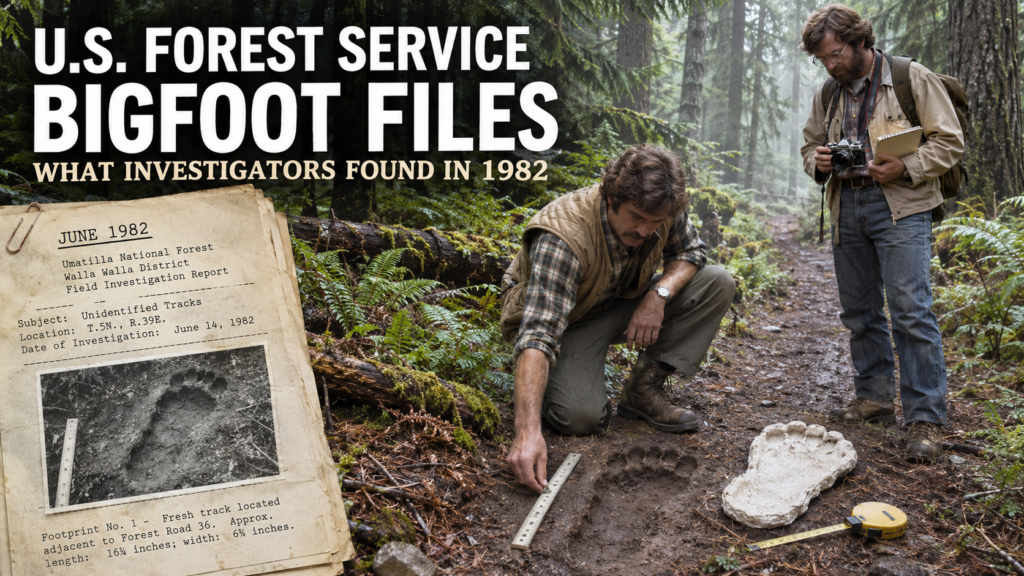
In June 1982, a U.S. Forest Service employee reported seeing a mysterious, hair covered creature in the mountains near Walla Walla, Washington.
Days later, unusual footprints discovered in the same general region prompted an official investigation.
The tracks were large. Some measured approximately 15 inches long. Their unusual appearance raised questions about what could have made them.
Wildlife specialists examined the evidence. Photographs were taken, plaster casts were created, and an experienced tracker inspected the surrounding terrain.
More than four decades later, those records have attracted renewed attention.
On October 15, 2026, the U.S. Forest Service published historical documents under the heading Bigfoot/Sasquatch Records in its Freedom of Information Act reading room.
The release brought the 1982 investigation back into public discussion. However, the original documents tell a more complicated story than headlines suggesting the government discovered Bigfoot.
The investigators found unusual footprints, but they did not confirm the existence of an unknown creature. In fact, their written conclusions raised serious doubts about the tracks.
Understanding what the U.S. Forest Service Bigfoot files actually reveal requires examining the original evidence, the investigators’ observations, and the disagreement that followed.
What Did the U.S. Forest Service Bigfoot Investigation Actually Find?
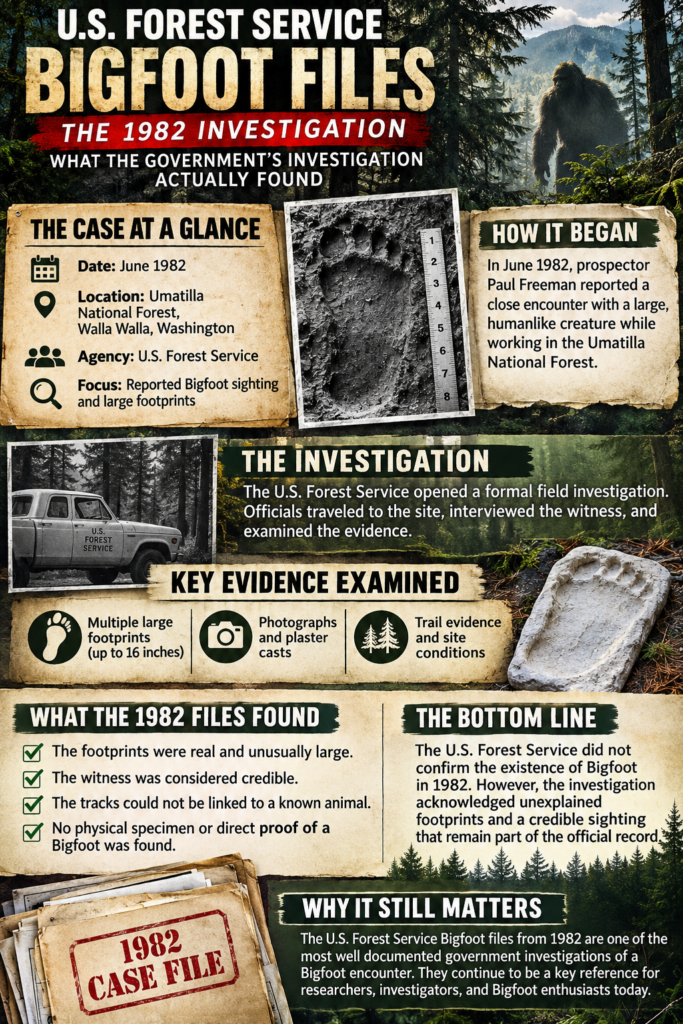
The 1982 U.S. Forest Service Bigfoot investigation documented unusual humanlike footprints in the Mill Creek Watershed of the Umatilla National Forest. Investigators photographed the impressions, produced plaster casts, and examined the surrounding terrain. Wildlife biologist Rodney L. Johnson concluded that the tracks were not made by a large, two legged creature. A U.S. Border Patrol tracker, Joel Hardin, separately concluded that the tracks were part of an elaborate hoax.
Neither investigator identified the person who might have created the impressions.
Their findings also did not establish what Paul Freeman had actually seen earlier that month.
That distinction is important. The investigation produced a documented assessment of suspicious footprints, not a definitive explanation for every reported Bigfoot encounter in the region.
The original seven page document is available through the U.S. Forest Service’s official records archive.
The 1982 Bigfoot Sighting That Started the Investigation
Who Was Paul Freeman?
Paul Freeman worked as a watershed patrolman for the U.S. Forest Service in southeastern Washington.
His work brought him into remote sections of the Umatilla National Forest. Much of the terrain included wooded hillsides, secluded trails, and restricted watershed areas.
On June 10, 1982, Freeman reported an encounter with an animal unlike anything he had previously identified.
According to contemporary reporting and later accounts, Freeman described a tall creature covered in reddish brown hair. He believed it stood approximately eight feet tall.
He also reported an unpleasant odor associated with the encounter.
The alleged sighting occurred in the Tiger Creek area near Walla Walla.
Freeman believed the creature was Bigfoot, also known as Sasquatch.
His story quickly gained public attention.
A June 12, 1982, report from United Press International described the alleged encounter and identified Freeman as a Forest Service employee.
However, his employment did not independently verify the creature’s identity.
Freeman had reported what he believed he saw. Identifying the animal required evidence that could be examined separately from his account.
The Discovery of Additional Large Footprints
The story developed further when more unusual footprints were reported in the Mill Creek Watershed.
These impressions appeared in muddy areas and along trails.
Some resembled oversized human feet. Others appeared to show toes and unusual pressure patterns.
The discoveries attracted the attention of Forest Service personnel.
Rather than relying entirely on the witness reports, officials arranged for investigators to examine the locations.
On June 17, 1982, a group visited the reported track sites.
Their findings became the basis of the official Forest Service memorandum dated June 18, 1982.
Watch: Paul Freeman’s Bigfoot Footprint Evidence and Investigation
Paul Freeman became one of the most controversial figures in Bigfoot research after reporting a mysterious encounter in Washington in 1982.
This archival video from 1994 offers a closer look at Freeman’s later investigations. It includes footage of unusual footprints and the process of creating plaster casts.
Although this video was recorded years after the original U.S. Forest Service Bigfoot investigation, it provides valuable historical context for understanding Freeman’s research methods and the footprint evidence associated with his name.
Watch Below:
Paul Freeman Bigfoot Home Video
The footage does not independently verify that Bigfoot exists. However, it allows viewers to examine aspects of the evidence and investigative methods that continue to generate debate.
Inside the Original 1982 U.S. Forest Service Bigfoot Files
The original report carries the subject heading Documentation of Investigation into Sighting of “Bigfoot” Tracks in the Mill Creek Watershed.
It was prepared by Rodney L. Johnson, a wildlife biologist working with the Umatilla National Forest.
The memorandum was addressed to Roger E. Baker, a Forest Service resource staff member.
Johnson documented the field investigation and described three reported locations.
The locations were identified as Site A, Site B, and Site C.
Each presented different conditions and different amounts of physical evidence.
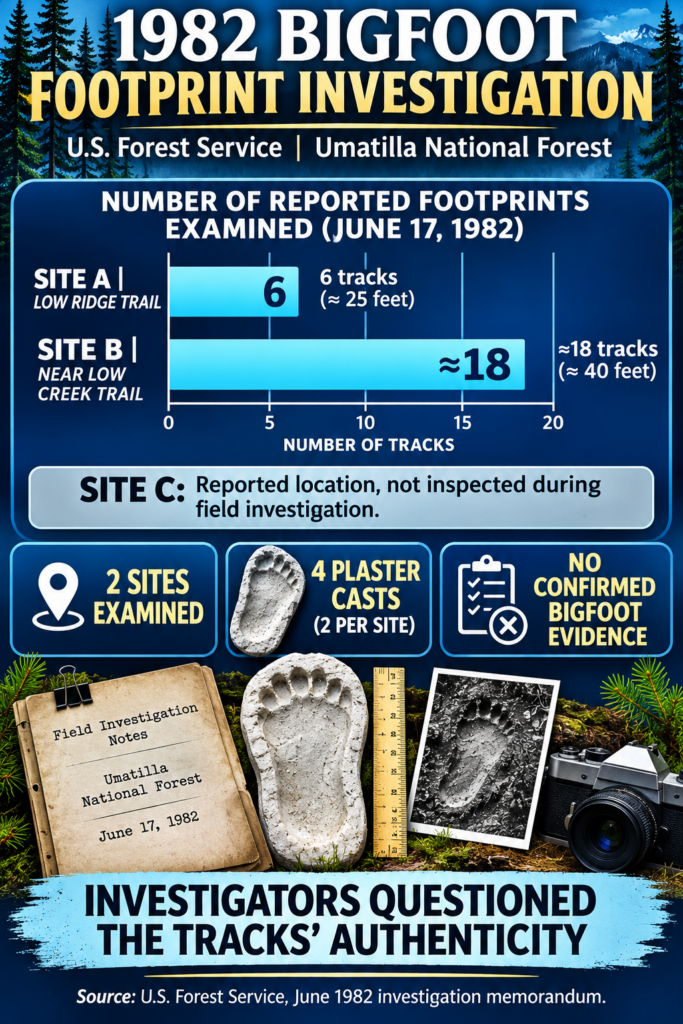
Site A: Six Unusual Footprints Along a Forest Trail
Site A was located along the Low Ridge Trail, approximately 1.5 miles above Mill Creek.
Investigators documented six recognizable tracks extending about 25 feet.
The surrounding area contained mud and relatively dense vegetation.
Several impressions appeared large enough to justify closer examination.
One right footprint measured approximately 15 inches long and seven inches wide at its broadest point.
Another impression, identified as a left footprint, measured approximately 15 inches long and 6.5 inches wide.
Investigators photographed the tracks and made two plaster casts.
However, the tracking specialist noticed something troubling.
The apparent footprints did not form the kind of continuous trail he expected from a large animal traveling through the area.
Beyond the visible impressions, he could not find convincing evidence of the creature’s passage.
That observation later became an important part of the investigation’s conclusion.
Site B: Eighteen Tracks Near a Bog
Site B was located near a bog beside the Low Creek Trail, approximately 2.75 miles above Mill Creek.
Investigators found approximately 18 impressions extending over 40 feet.
Some impressions appeared in soft mud. Others continued toward a small rise and into vegetation.
The area showed signs of disturbance beyond the visible trackway.
At first, this might have suggested that something large had moved through the vegetation.
However, the investigators examined the shape and placement of the impressions.
They photographed the tracks and made two plaster casts.
One impression contained a rock within the apparent arch area.
Other tracks displayed unusual toe formations.
These details would later produce disagreement between investigators and Bigfoot researchers.
Site C: A Reported Trackway That Was Not Examined
The third location was described as a dry, open area containing approximately 12 individual tracks.
However, the investigation team did not visit Site C.
The report explains that time limitations and concerns raised by the evidence at Site B influenced that decision.
The investigators relied on descriptions of the tracks instead.
This creates an important limitation in the official record.
Site C was reported, but it was not independently inspected by the group during that investigation.
Therefore, its reported impressions cannot be treated as verified physical evidence from the June 17 field examination.
Eight Reasons the Forest Service Biologist Questioned the Bigfoot Tracks
The most revealing part of the U.S. Forest Service Bigfoot files appears in Johnson’s conclusions.
His report identified eight observations that made him question whether the impressions had been created by a large living creature.
These concerns focused on how the footprints interacted with mud, slopes, vegetation, and surrounding terrain.
1. The Footprint Stride Remained Unusually Consistent
Johnson reported that the observed tracks maintained a stride of approximately four feet.
The stride did not change substantially when the terrain became steeper.
A living animal would normally adjust its movements to compensate for changes in slope.
Walking uphill generally shortens a person’s stride. Walking downhill can produce a different pattern.
Johnson expected some variation.
The consistent spacing appeared suspicious to him.
2. The Impressions Did Not Sink as Deeply as Expected
The tracks were attributed to a creature supposedly weighing more than 300 pounds.
However, Johnson observed that the apparent footprints did not penetrate the muddy ground as deeply as expected.
He noted that investigators wearing boots sank farther into the mud at some of the same locations.
Footprint depth alone cannot establish an animal’s exact weight. Soil conditions and movement also matter.
Still, the difference raised doubts about whether the impressions came from an unusually heavy animal.
3. The Tracks Began and Ended Abruptly
The alleged Bigfoot tracks appeared in isolated sections.
They had recognizable starting and ending points.
Investigators could not consistently follow them into a longer trail.
This was different from the many animal tracks they observed in the forest.
Johnson noted that deer and bear tracks could often be followed across surrounding terrain.
The sudden appearance and disappearance of the larger footprints made him question how they had been produced.
4. Some Foot Details Appeared Too Distinct
Several impressions displayed clearly defined markings in areas where Johnson expected greater wear or irregularity.
He questioned whether the apparent sole surfaces were consistent with the feet of a large animal traveling through rough terrain.
The unusual details were not enough to identify a specific method of fabrication.
However, they contributed to his suspicion that the tracks were artificial.
5. Forest Debris Appeared to Have Been Moved Aside
At Site B, investigators noticed the arrangement of forest litter around some impressions.
Johnson believed needles and other small debris had been pushed aside before the tracks were made.
The displaced material appeared unnatural to him.
A real foot pressing into the forest floor should interact with loose material already covering the ground.
For Johnson, the arrangement suggested possible human preparation of the surface.
6. The Smaller Toes Lacked Expected Pressure Details
The report questioned the shape of the smaller toes.
Johnson expected to see more defined pressure areas where the toes contacted the ground and pushed away.
Instead, several impressions lacked those details.
He considered the appearance inconsistent with normal foot movement.
The concern was not simply the size of the prints. It involved how a living foot would function while walking.
7. There Was Little Evidence of Slipping on Slopes
The tracks crossed areas with noticeable changes in elevation.
Despite those conditions, Johnson found little evidence of expected heel or toe slippage.
Walking across muddy slopes often creates signs of shifting weight.
A foot may slide backward while climbing or move forward while descending.
The absence of these expected signs made the impressions less convincing to the biologist.
8. Some Tracks Suggested a Rocking Motion
Johnson also observed shapes that appeared to result from side to side movement.
In certain impressions, the apparent arch area was compressed in an unusual way.
Some tracks appeared wider than others.
He considered whether an object had been rocked or pressed into the mud rather than a living foot moving naturally through it.
This observation strengthened his doubts about the trackway.
What Did the U.S. Border Patrol Tracker Conclude?
The Forest Service investigation also included an assessment from Joel Hardin, an experienced tracker associated with the U.S. Border Patrol.
Hardin examined the reported footprints during the June 17 investigation.
In a memorandum dated July 28, 1982, he provided his conclusions to Forest Service personnel.
His assessment was more direct than Johnson’s.
Hardin believed the tracks were part of a deliberate hoax.
He suggested that someone had used an artificial foot made from materials such as plaster or rubber.
His reasoning included several observations.
The tracks appeared remarkably similar across separate locations. Some did not compress the soil as expected. Others maintained an unusually regular stride.
He also questioned why the impressions appeared in certain areas without corresponding signs of movement through nearby terrain.
Hardin believed the person responsible had detailed knowledge of Bigfoot stories and access to the area.
However, the memorandum did not identify a perpetrator or establish that any particular individual had fabricated the footprints.
His conclusion was an expert interpretation of the physical evidence.
It was not a criminal finding supported by an identified suspect.
Why Anthropologist Grover Krantz Disagreed With the Investigation
Not everyone who examined the Mill Creek evidence agreed with the Forest Service investigators.
One of the most notable critics was Grover Krantz, an anthropology professor at Washington State University.
Krantz had a longstanding interest in Bigfoot research.
He studied plaster casts associated with the 1982 discoveries and reached a different interpretation.
The Controversy Over Dermal Ridges
Krantz focused on fine details visible in some footprint casts.
These details appeared to resemble dermal ridges.
Dermal ridges are the raised patterns found on human fingertips, palms, and soles.
According to Krantz, some casts also preserved tiny features that resembled sweat pores.
He argued that the impressions showed anatomical complexity consistent with the skin of a primate.
In his published analysis, Anatomy and Dermatoglyphics of Three Sasquatch Footprints, Krantz examined the structure of three casts from the Elk Wallow area.
He believed their dimensions and surface details supported the possibility that the impressions came from an unknown large primate.
Why the Dermal Ridge Claims Remain Disputed
The presence of apparent skin patterns does not automatically establish the identity of the trackmaker.
Even a convincing anatomical impression leaves important questions.
Investigators must determine how it was created, whether the material was altered, and whether the original track can be reliably connected to a living animal.
Krantz interpreted the unusual details as evidence of authenticity.
Johnson and Hardin focused heavily on the surrounding terrain and the way the tracks appeared to have been formed.
Their approaches produced different conclusions.
The disagreement remains significant because the same physical evidence can look convincing when isolated from its environmental context.
A realistic footprint cast is not necessarily proof that an unknown animal made it.
Likewise, the investigators’ suspicion of fabrication did not establish exactly who made the tracks or how.
The available record supports the existence of a serious disagreement over the evidence. It does not resolve the biological question.
Why Were the U.S. Forest Service Bigfoot Files Released in 2026?
On October 15, 2026, the Forest Service added a collection titled Bigfoot/Sasquatch Records to its official Freedom of Information Act reading room.
The listing included three historical documents.
The collection consisted of the 1982 Umatilla National Forest investigation, a historical Montana account written by Leo T. Kinney, and a newspaper article about unusual tracks in Montana.
The newly accessible material brought historical sightings and government recordkeeping into the spotlight.
The release attracted national attention in November 2026.
However, the documents were not newly conducted investigations.
They were existing records made available for public examination.
There is also an important difference between releasing government records and declassifying secret evidence.
The Forest Service reading room identifies these materials as frequently requested records.
Their publication does not establish that the agency had previously classified them as secret.
The official Forest Service FOIA reading room provides direct access to the collection.
Does Releasing Bigfoot Records Mean the Government Believes Bigfoot Exists?
No.
A government agency can preserve information about a reported event without accepting every claim in that report.
For example, an agency may document an unusual footprint, investigate a witness statement, or examine an unidentified sound.
Those actions establish that the report was received or investigated.
They do not automatically establish that the proposed explanation was correct.
The 1982 Forest Service investigation illustrates this distinction clearly.
Federal personnel examined the evidence and recorded their professional judgments.
Those judgments did not confirm the existence of Sasquatch.
What the Government’s Bigfoot Investigation Did Not Prove
The recently published files offer an interesting historical record.
However, several important claims cannot be established from the documents.
The investigation did not provide:
- A recovered Bigfoot body or skeleton.
- Verified DNA identifying an unknown primate.
- A scientifically confirmed new animal species.
- Conclusive proof that Paul Freeman encountered Bigfoot.
- A verified identification of the person responsible for the suspicious tracks.
- Evidence of a secret federal program protecting Bigfoot.
- Proof that the U.S. Forest Service officially recognized Sasquatch as a real animal.
These limitations matter.
The footprints were real impressions in the ground. Their appearance was documented.
But identifying what created an impression requires more than determining that the impression exists.
That is the difference between recording unusual evidence and proving a claim about its origin.
How the 1982 Investigation Compares With Other Government Bigfoot Files
The Forest Service is not the only federal agency whose records have become part of Bigfoot history.
The FBI also released historical documents related to alleged Sasquatch evidence.
Those records involved correspondence with Bigfoot researcher Peter Byrne during the 1970s.
Byrne sought assistance in examining hairs believed to be associated with Bigfoot.
The FBI Laboratory eventually analyzed submitted material.
Its conclusion was that the examined hairs came from the deer family.
The findings did not establish the existence of Sasquatch.
The FBI’s official Bigfoot file remains publicly accessible.
Although these federal records concern different incidents, they demonstrate a similar principle.
Government involvement does not necessarily mean government confirmation.
One agency assessed suspicious footprints. Another examined alleged hair evidence.
Neither investigation produced verified proof of an unknown North American primate.
What Would Investigators Need to Confirm a Bigfoot Discovery?
The 1982 investigation raises an important question.
What kind of evidence would be necessary to establish that Bigfoot is a real, previously unrecognized species?
Extraordinary stories can inspire an investigation. However, the strongest conclusions require evidence that independent researchers can examine.
Consistent and Documented Footprint Evidence
A convincing trackway should show continuous movement through an identifiable environment.
Investigators would need to document the substrate, the spacing between impressions, and the way the feet interacted with surrounding objects.
Photographs should include reliable measurements and multiple viewing angles.
Casts should be connected to documented locations and collection procedures.
Even then, footprint evidence would require careful comparison with known animals and possible fabrication methods.
Independently Verifiable Biological Samples
Hair, tissue, blood, or other biological material could provide stronger evidence.
However, samples must be collected carefully.
Researchers must account for contamination and establish reliable records showing where the material came from.
Independent laboratories would need to verify the findings.
An unexplained laboratory result would not automatically identify Bigfoot. Researchers would still need to rule out known organisms and testing problems.
A Physical Specimen or Other Conclusive Evidence
A properly documented biological specimen would provide the clearest opportunity to examine anatomy, genetics, and classification.
Researchers could compare it with known species.
Independent experts could evaluate the findings and publish their conclusions.
This process would allow an extraordinary claim to move beyond witness accounts and ambiguous photographs.
Until evidence of that quality is produced, Bigfoot remains an unverified creature within mainstream zoology.
Why the 1982 Bigfoot Case Still Matters
The Mill Creek investigation remains interesting for reasons beyond the possibility of a previously unknown animal.
First, it provides a documented example of government personnel examining an unusual wildlife claim.
Second, it preserves the observations of investigators who examined the physical locations.
Third, it shows how different researchers interpreted the same general body of evidence.
The Forest Service investigators concentrated on track placement, movement patterns, and environmental inconsistencies.
Krantz concentrated on anatomical characteristics preserved in selected casts.
Both approaches illustrate the importance of examining evidence carefully.
However, neither interpretation should be accepted simply because of the investigator’s professional title.
The strength of a conclusion depends on the evidence supporting it.
The case also highlights the difference between an unresolved witness experience and an investigated physical claim.
Freeman’s reported encounter and the later footprint discoveries are related historically.
They are not identical forms of evidence.
Questioning the authenticity of the footprints does not establish what Freeman saw.
Likewise, believing Freeman’s account does not automatically establish that the later tracks were genuine.
Each claim requires its own examination.
Frequently Asked Questions About the U.S. Forest Service Bigfoot Files
Did the U.S. Forest Service officially investigate Bigfoot in 1982?
Yes. Forest Service personnel investigated unusual footprints reported in the Mill Creek Watershed of the Umatilla National Forest. The field investigation took place on June 17, 1982, and wildlife biologist Rodney L. Johnson prepared a written report dated June 18.
Did the government find proof of Bigfoot?
No. The investigators documented unusual footprints, but their conclusions did not support identifying the impressions as evidence of a large unknown creature.
Who was the Forest Service employee who reported seeing Bigfoot?
Paul Freeman was a watershed patrolman who reported seeing a large, reddish brown, hair covered creature near Walla Walla, Washington, in June 1982.
Were the Bigfoot footprints declared fake?
The investigators concluded that the tracks were inconsistent with a large living creature. Border Patrol tracker Joel Hardin specifically believed they were an elaborate hoax. However, the released report did not identify who allegedly fabricated them.
Did Grover Krantz believe the footprints were authentic?
Yes. Anthropologist Grover Krantz examined casts associated with the discoveries and argued that their anatomy and apparent dermal ridges supported authenticity. His interpretation differed substantially from the investigators’ conclusions.
When were the Forest Service Bigfoot records released?
The U.S. Forest Service posted the historical documents in its public FOIA reading room on October 15, 2026.
Are the original Bigfoot investigation documents available online?
Yes. The original investigation report and related documents are available through the official U.S. Forest Service FOIA reading room.
Final Conclusion: What the 1982 Government Bigfoot Files Really Reveal
The U.S. Forest Service Bigfoot files provide something valuable that many paranormal investigations lack.
They provide original government documentation.
The 1982 investigation recorded unusual footprints, field observations, photographs, and plaster casts.
It also preserved the conclusions of professionals who inspected the evidence.
Rodney L. Johnson identified several physical inconsistencies in the tracks.
Joel Hardin believed the impressions had been deliberately fabricated.
Grover Krantz later offered a competing interpretation based on the anatomical details preserved in selected casts.
The disagreement makes the case worth studying.
However, the most important finding is that the government investigated unusual footprints without confirming that Bigfoot created them.
The files document an investigation, not the discovery of an unknown species.
For paranormal researchers, the case offers a useful reminder.
An interesting witness report deserves careful attention, but an extraordinary conclusion requires independently verifiable evidence.
More than forty years after the investigation, the original documents remain available for anyone willing to examine what the investigators actually recorded.
The mystery of Bigfoot continues.
But the government records themselves are no longer difficult to find.
Sources and References
1. U.S. Forest Service. June 18, 1982.
Documentation of Investigation into Sighting of “Bigfoot” Tracks in the Mill Creek Watershed.
Original government memorandum by wildlife biologist Rodney L. Johnson, with a separate July 28, 1982, assessment by tracker Joel Hardin.
Read the original government investigation PDF
2. U.S. Forest Service. October 15, 2026.
Bigfoot/Sasquatch Records.
Official publication of historical records in the Forest Service Freedom of Information Act reading room.
View the official Forest Service records
3. Grover S. Krantz.
Anatomy and Dermatoglyphics of Three Sasquatch Footprints.
A detailed examination of footprint casts associated with the 1982 Mill Creek discoveries. The North American Wood Ape Conservancy hosts a version of the analysis.
Read Krantz’s footprint analysis
4. United Press International. June 12, 1982.
Contemporary news coverage documenting Paul Freeman’s reported sighting in the Tiger Creek area.
Read the historical UPI report
5. Federal Bureau of Investigation.
Bigfoot, Part 01.
Official historical records concerning the FBI’s examination of hair submitted as possible Bigfoot evidence.
6. Skeptical Inquirer.
Paul Freeman’s Magic Bigfoot Track.
A skeptical examination of the Freeman footprint claims and the interpretations offered by investigators and researchers.
About the Author: Kevin Mack
Kevin Mack | Paranormal Investigator, Researcher, and Founder of Paraghosts.com
Kevin Mack is a paranormal investigator, researcher, and freelance writer with over 15 years of experience exploring unexplained phenomena.
As the founder of Paraghosts.com, he researches ghost sightings, paranormal investigations, cryptid encounters, Bigfoot reports, and historical mysteries.
Kevin specializes in examining eyewitness accounts, historical documents, government records, and reported paranormal evidence.
His research emphasizes separating documented facts from speculation while exploring the mysteries that continue to interest investigators worldwide.
Website: Paraghosts.com
Article Updated: November 20, 2026