By Kevin Mack, Paranormal Research Writer and Ghost Investigation Specialist | March 25, 2026
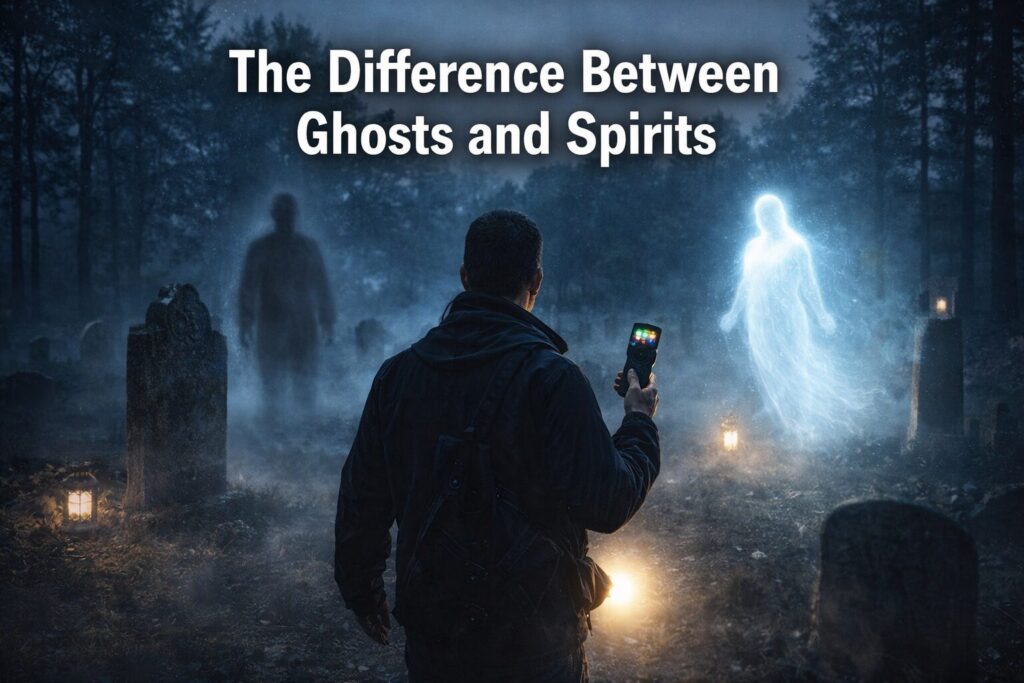
In paranormal investigation, a ghost is often treated as the lingering presence, imprint, or earthbound consciousness of a deceased person, while a spirit is usually viewed as a more aware, responsive, and nonphysical entity that can interact intentionally. In simple terms, ghosts are often described as tied to a place or event, while spirits are often described as more intelligent and communicative.
Contents
- Introduction: The Difference Between Ghosts and Spirits
- Why This Question Matters in Real Paranormal Work
- Difference Between Ghosts and Spirits in Paranormal Investigation: Core Definitions
- Paranormal Investigation Relies on Patterns, Not Certainty
- How I Tell the Difference During an Investigation
- Key Signs That a Case May Involve a Ghost
- Key Signs That a Case May Involve a Spirit
- Common Mistakes and Misconceptions
- Expert Insights From Real-World Investigation Thinking
- Practical Tips and Best Practices
- Frequent Asked Questions
- Final Thoughts
Introduction: The Difference Between Ghosts and Spirits
Difference between ghosts and spirits in paranormal investigation refers to how investigators classify human hauntings, residual energy, and intelligent entities.
When people ask me about the difference between ghosts and spirits in paranormal investigation, they are usually trying to solve a real problem.
They want to know what they are dealing with during an investigation. They want to know whether a haunting feels like replayed energy, an intelligent presence, or something else entirely.
That distinction matters because it changes how I investigate, how I document evidence, and how I interpret activity in a home, business, cemetery, or historic site.
In my experience, many beginners use the words ghost and spirit as if they mean exactly the same thing. In casual conversation, that is common.
In field investigation, though, I treat them differently because the behavior patterns often look different. A ghost is often described as a dead person’s lingering presence or imprint.
A spirit is usually treated as a conscious nonphysical being that can interact with people in a more intelligent way.
Britannica defines a ghost as the soul or spectre of a dead person believed to return to the world of the living, which helps explain why the two terms are often blended in popular culture.
That said, paranormal investigation is not a hard science with one universal glossary. Different teams, researchers, mediums, and religious traditions use these labels differently.
So the most useful answer is not just dictionary-based. It is practical. It is based on patterns, context, and the kind of evidence that shows up during an investigation. That is exactly what this article will cover.
Why This Question Matters in Real Paranormal Work
This is not just a word game. I have seen investigators mislabel activity because they skipped the classification step.
If I assume every unexplained event is an intelligent haunting, I may start asking questions, running communication sessions, and interpreting device responses in a way that leads to weak conclusions.
If I assume everything is only residual, I may ignore signs of actual interaction.
The label affects the investigation strategy. It affects how I set up trigger objects. It affects whether I focus more on environmental mapping, audio review, historical research, controlled questioning, or witness psychology.
It also affects how I talk to frightened clients. People feel better when the explanation is careful, measured, and honest.
Difference Between Ghosts and Spirits in Paranormal Investigation: Core Definitions
What I mean by “ghost”
In my working definition, a ghost is usually one of these two things:
- A deceased human presence that appears stuck, attached, or repeatedly observed in the same environment
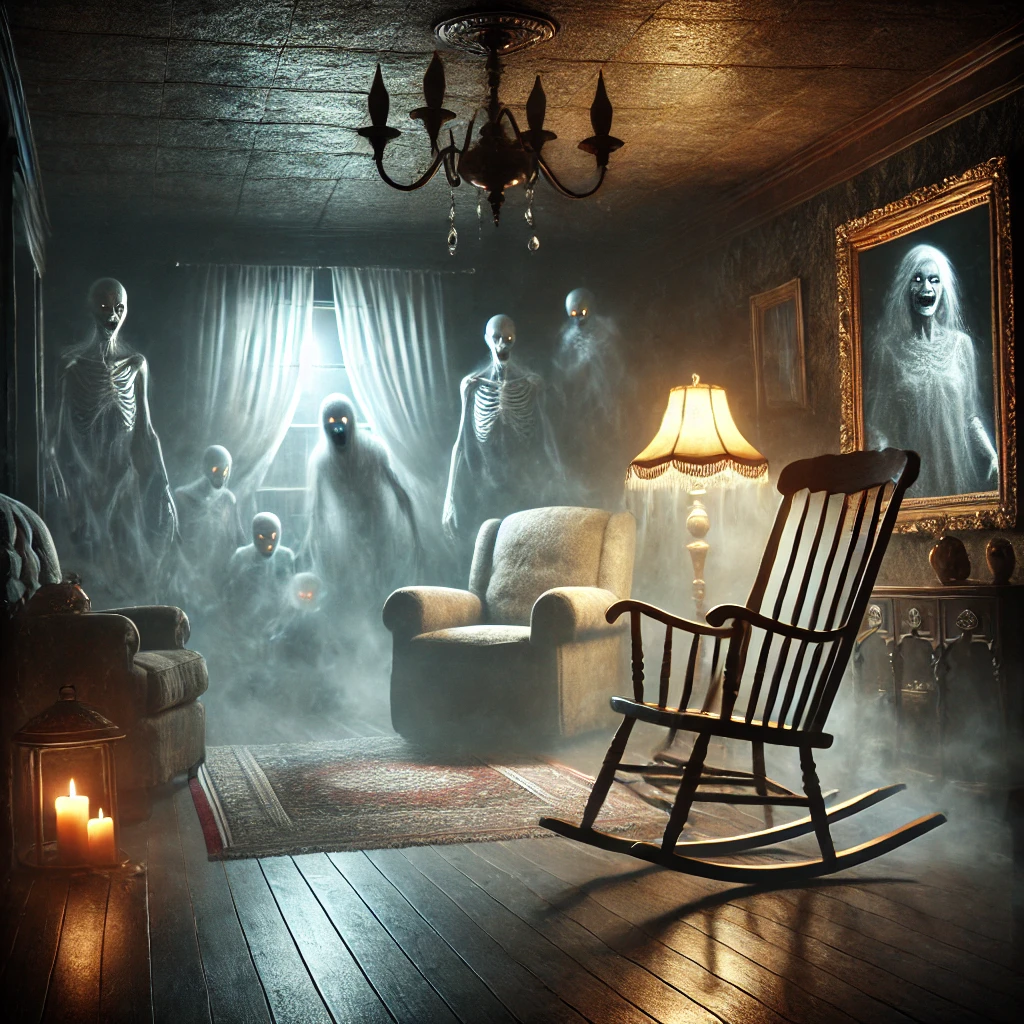
- A residual imprint that seems to replay past emotion, movement, sound, or behavior without awareness
This is why many ghost reports involve repetition. The same footsteps. The same figure on the stairs. The same door opening at the same hour. The same shadow crossing the hallway. These cases often feel location-bound.
What I mean by “spirit”
In my working definition, a spirit is usually a conscious nonphysical presence with some level of awareness, intent, and responsiveness. A spirit may be human in origin, or in some belief systems, not necessarily human at all.
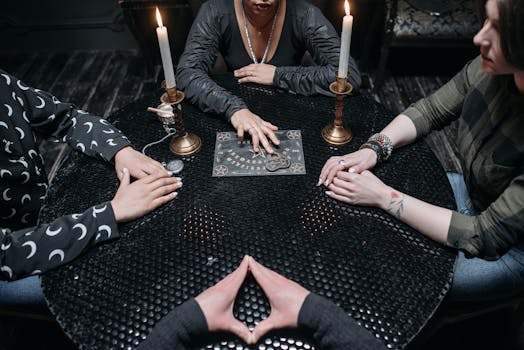
In practical paranormal investigation, though, many teams use the word spirit to mean an entity that can respond to questions, show selective behavior, and interact with people in the moment.
When I document a possible spirit case, I am looking for signs of intelligence.
I want to know whether the activity changes based on who is present, what is said, or what object is introduced. I want to know whether the timing is random or interactive.
Why the terms overlap so much
This is where people get confused, and honestly, I understand why. In books, TV shows, religious beliefs, folklore, and online paranormal content, the words are constantly mixed together.
Some investigators use ghost as the umbrella term for all deceased-human hauntings. Others use spirit as the umbrella term. Some reserve ghost for hauntings and spirit for communication cases. There is no universal rule.
That is why I always define my terms at the start of an investigation report. It keeps the case logic clear.
Paranormal Investigation Relies on Patterns, Not Certainty
One of the biggest mistakes I see online is people speaking with total certainty about categories that are still debated.
Good investigators do not do that. We work with patterns, witness testimony, environmental conditions, and repeatable observations. We classify carefully. We stay open to natural explanations first.
That means when I say something looks more like a ghost than a spirit, I am not claiming absolute proof. I am saying the evidence pattern fits one model better than another.
Residual versus intelligent activity
This distinction matters more than the word choice itself.
Residual activity usually looks like this:
- Repeating sounds or movements
- No clear response to people
- The same event reported over and over
- A strong tie to trauma, routine, or location history
Intelligent activity usually looks like this:
- Timed responses to questions
- Behavior that changes with different people
- Selective interaction with objects
- Apparent awareness of being observed
In my field notes, ghost cases often lean residual. Spirit cases often lean intelligent. That is not always true, but it is a useful starting model.
How I Tell the Difference During an Investigation
Step 1: I start with witness interviews
I never begin with gadgets. I begin with people.
I ask witnesses what happened, when it happened, who was present, what changed, and whether the activity repeated in a pattern.
I ask about emotional events, renovations, family conflict, grief, sleep habits, pets, medication, sound sources, drafts, plumbing, and electrical issues.
This first step tells me whether I am looking at a pattern that seems replay-like or interactive.
If three people tell me they hear the same heavy footsteps in the upstairs hall every night at nearly the same time, that suggests residual behavior.
If the activity changes when someone speaks aloud or mentions a certain name, that suggests intelligence.
Step 2: I map the environment
Next, I study the location itself.
I look at layout, airflow, traffic sounds, reflective surfaces, loose boards, pipes, appliance cycles, power sources, EMF-producing devices, and sightlines.
I want to know what can naturally create fear, confusion, or misinterpretation. I also want to identify whether the activity clusters in one room, one hallway, one staircase, or around one object.
Ghost-like cases often stay tightly tied to place. Spirit-like cases may appear more selective and person-centered.
Step 3: I document repetition
This step is crucial.
If an event seems to repeat with little variation, I pay close attention. Repetition is one of the strongest clues that the event may be residual. A figure seen at the same landing. A scent in the same room.
A voice in the same time window. A sensation near the same doorway. These patterns do not prove anything on their own, but they help me separate replayed phenomena from responsive phenomena.
Step 4: I test for interaction
Only after I understand the baseline do I test for possible intelligence.
I use controlled questions. I vary wording. I separate investigators. I change the environment as little as possible.
I note whether responses appear meaningful or if they only seem meaningful because we want them to be. This is where many investigations go wrong. People force a story onto random noise.
A possible spirit case should show more than one weak coincidence. I want layered indicators. Timing. relevance. consistency. selective response.
Step 5: I compare evidence against behavior models
Once I gather interviews, environmental notes, audio, video, and event logs, I compare the total picture.
If the case is repetitive, location-bound, and nonresponsive, I lean toward ghost or residual haunting language.
If the case is aware, selective, responsive, and interactive, I lean toward spirit language.
If it is messy, inconsistent, or poorly documented, I say that clearly. Good investigation includes uncertainty.
Key Signs That a Case May Involve a Ghost
These are signs I personally watch for when activity appears more ghost-like than spirit-like:
- Repeated appearances in the same spot
A figure seen in one hall, stairwell, or doorway over and over often suggests a location-tied pattern rather than free interaction. - Nonresponsive phenomena
If footsteps, voices, or apparitions continue regardless of who is present or what is said, I become more cautious about calling it intelligent. - Historical emotional imprint
Some locations feel tied to a traumatic event, daily routine, or strong human emotion. Reports often mirror that history in repetitive ways. - Predictable timing
Events that recur at similar times can suggest a repeated pattern instead of a conscious decision to interact. - No meaningful change during sessions
If questioning, trigger objects, and controlled prompts do not change the activity at all, that weakens the spirit hypothesis.
Key Signs That a Case May Involve a Spirit
When I suspect spirit activity, I look for stronger signs of awareness:
- Directly timed responses
A sound, light anomaly, device change, or audio event that consistently follows specific prompts deserves closer attention. - Selective interaction with certain people
Some cases seem to focus on one person in a family, one investigator, or one emotional state. That pattern can suggest intention. - Context-aware behavior
If activity changes when a name, memory, object, or question is introduced, that feels more responsive than residual. - Movement beyond one fixed area
A presence that appears in different locations with meaningful timing may be less tied to a single environmental replay. - Clear communication attempts
This does not mean every EVP is real communication. But cases with repeated, relevant, and context-linked responses demand closer review.

Common Mistakes and Misconceptions
Mistake 1: Assuming every haunting is intelligent
This is one of the biggest errors in beginner investigation. Not everything talks back. Not every knock is a response. Not every device hit is meaningful. Many cases become exaggerated because investigators begin with a spirit narrative instead of testing alternatives first.
Mistake 2: Treating devices as proof
No meter, app, or recorder can tell you “ghost” or “spirit” with certainty. Devices can support observations. They do not replace analysis. I use tools, but I never let them do the thinking for me.
Mistake 3: Ignoring natural causes
Old houses make noise. HVAC systems create cold spots. Pets react to ordinary sounds. Light reflections create human-shaped illusions. Fear fills in blanks. Strong investigators rule out the ordinary before exploring the extraordinary.
Mistake 4: Believing every ghost is trapped and suffering
Popular media pushes this idea constantly. In my experience, cases are more varied than that. Some reports feel like imprints. Some feel human and aware. Some feel symbolic. Some fall apart under scrutiny.
Mistake 5: Thinking ghost and spirit have one universal definition
They do not. That is why experienced investigators explain how they are using the terms.
Expert Insights From Real-World Investigation Thinking
Over time, I have learned that classification is less about dramatic labels and more about disciplined observation.
The strongest investigators I know are not the loudest. They are the most careful. They take notes. They compare witness accounts. They do repeat visits. They resist building a story too early.
My own approach has changed over the years. Early on, I was too eager to interpret intelligent activity. I wanted meaning in every anomaly.
Experience taught me to slow down. Once I started separating repetitive phenomena from responsive phenomena, my case assessments became cleaner and more credible.
I have also learned that fear often pushes witnesses to prefer one label over another. Some people feel less afraid if I say “residual ghost.”
Others feel more comforted by “spirit,” especially if they associate that word with loved ones who have passed on. That is why I choose words carefully. My job is not to sensationalize. My job is to investigate responsibly.
Practical Tips and Best Practices
Use a consistent case definition
Before your investigation begins, define what you mean by ghost, spirit, residual haunting, and intelligent haunting. This keeps your notes consistent and reduces confusion later.
Build timelines
Create a written event timeline from witness testimony. Patterns are easier to spot when everything is laid out by date, time, location, and trigger.
Separate experience from interpretation
Write down exactly what happened first. Add your theory second. For example:
- Good note: “Single footstep heard in back hall at 9:14 p.m.”
- Weak note: “Spirit walked through the hall”
The first is evidence language. The second is conclusion language.
Look for clusters, not single events
One strange noise means very little. Five related events with consistent context mean much more. I never build a case on one dramatic moment alone.
Stay humble
The best paranormal work leaves room for doubt. That does not weaken your findings. It strengthens your credibility.
Frequent Asked Questions
Are ghosts and spirits the same thing in paranormal investigation?
Not always. Many people use the words interchangeably, but many investigators do not. In field work, a ghost is often treated as a lingering or location-bound presence, while a spirit is often described as a more aware and interactive nonphysical entity. The exact wording varies by team, but the practical distinction usually comes down to repetition versus intelligence.
What is a ghost in paranormal investigation?
A ghost is often defined as the lingering presence or imprint of a deceased person. Some investigators believe ghosts are earthbound human presences, while others use the term for residual hauntings that replay like recordings. In many cases, ghost reports involve repeated sounds, apparitions, or sensations that seem tied to one place, one event, or one emotional history.
What is a spirit in paranormal investigation?
A spirit is usually described as a conscious nonphysical entity that can respond, interact, or show awareness. Investigators may use the word for a deceased human consciousness or for a broader category of nonphysical beings, depending on their beliefs. In practical casework, the term often suggests intelligent activity rather than passive replayed phenomena.
How can investigators tell if activity is residual or intelligent?
Investigators usually look for patterns. Residual activity tends to repeat without reacting to people. Intelligent activity appears more selective and responsive. Strong indicators include whether the event changes when questions are asked, whether it follows certain people, whether it happens in one fixed pattern, and whether multiple pieces of evidence support the same conclusion.
Can a ghost become a spirit in paranormal theory?
Some belief systems would say no because the terms mean different categories. Others would say the difference is only in how the presence behaves or is perceived. In practical paranormal investigation, this question is often less useful than asking whether the activity is repeating automatically or interacting intentionally in the moment.
Do all investigators agree on the difference between ghosts and spirits?
No. That is one of the most important things beginners need to understand. There is no single universal paranormal glossary accepted by every investigator, researcher, medium, or religious tradition. Many teams use the terms differently. The most credible investigators explain their working definitions clearly before drawing conclusions about a case.
Is a spirit more dangerous than a ghost?
Not automatically. The label itself does not determine risk. What matters is the reported behavior, the witness experience, and whether natural causes have been ruled out. Many so-called spirit cases involve calm, low-level interaction. Many ghost cases involve fear because of repetition and atmosphere rather than aggression. Risk should be assessed by behavior, not by buzzwords.
Why do people confuse ghosts and spirits so often?
People confuse them because movies, TV shows, folklore, religion, and social media mix the terms constantly. In casual speech, most people are not trying to make a technical distinction. In paranormal investigation, though, the difference matters because it shapes how evidence is gathered, how cases are classified, and how explanations are communicated to clients and audiences.
Final Thoughts
If you remember only one thing from this article, let it be this: the difference between ghosts and spirits in paranormal investigation is not just about vocabulary. It is about how the reported activity behaves.
That is the lens I use in the field. Is it repeating, fixed, and nonresponsive? I start thinking ghost or residual haunting. Is it aware, selective, and interactive? I start considering spirit activity.
I do not think good paranormal work comes from dramatic claims. I think it comes from patience, documentation, and humility.
The strongest investigations are the ones that separate witness experience from interpretation, respect natural explanations, and avoid turning every unexplained event into a sensational story.
That approach builds trust. It also makes your conclusions more useful to readers, clients, and fellow investigators.
In the end, both terms sit inside a bigger mystery. People have reported hauntings, presences, voices, apparitions, and intelligent encounters for generations.
The labels may vary, but the investigative task stays the same. Observe carefully. Define your terms. Follow the patterns. Let the case tell you what it is before you decide what to call it.
Citation Reference
About the Author
Kevin Mack is a Paranormal Research Writer and Ghost Investigation Specialist with hands-on experience studying hauntings, unexplained activity, and paranormal case patterns. He writes in-depth content focused on ghost behavior, spirits, haunted locations, and evidence-based paranormal investigation methods.
Sources and References
- Encyclopaedia Britannica – “Ghost”
Covers the traditional definition of a ghost as the soul or specter of a dead person believed to return to the world of the living.
Link: Encyclopaedia Britannica – Ghost - Merriam-Webster – “Spirit”
Useful for defining spirit as an animating principle, soul, or supernatural being, which helps support the distinction between ghost and spirit in your article.
Link: Merriam-Webster – Spirit
Disclaimer
This article is for informational and entertainment purposes only. Paranormal experiences are subjective, and interpretations of ghosts, spirits, and related activity can vary widely based on personal beliefs, investigation methods, and natural explanations.